
Is Your Garden City Water Softener Leaking Onto the Slab?
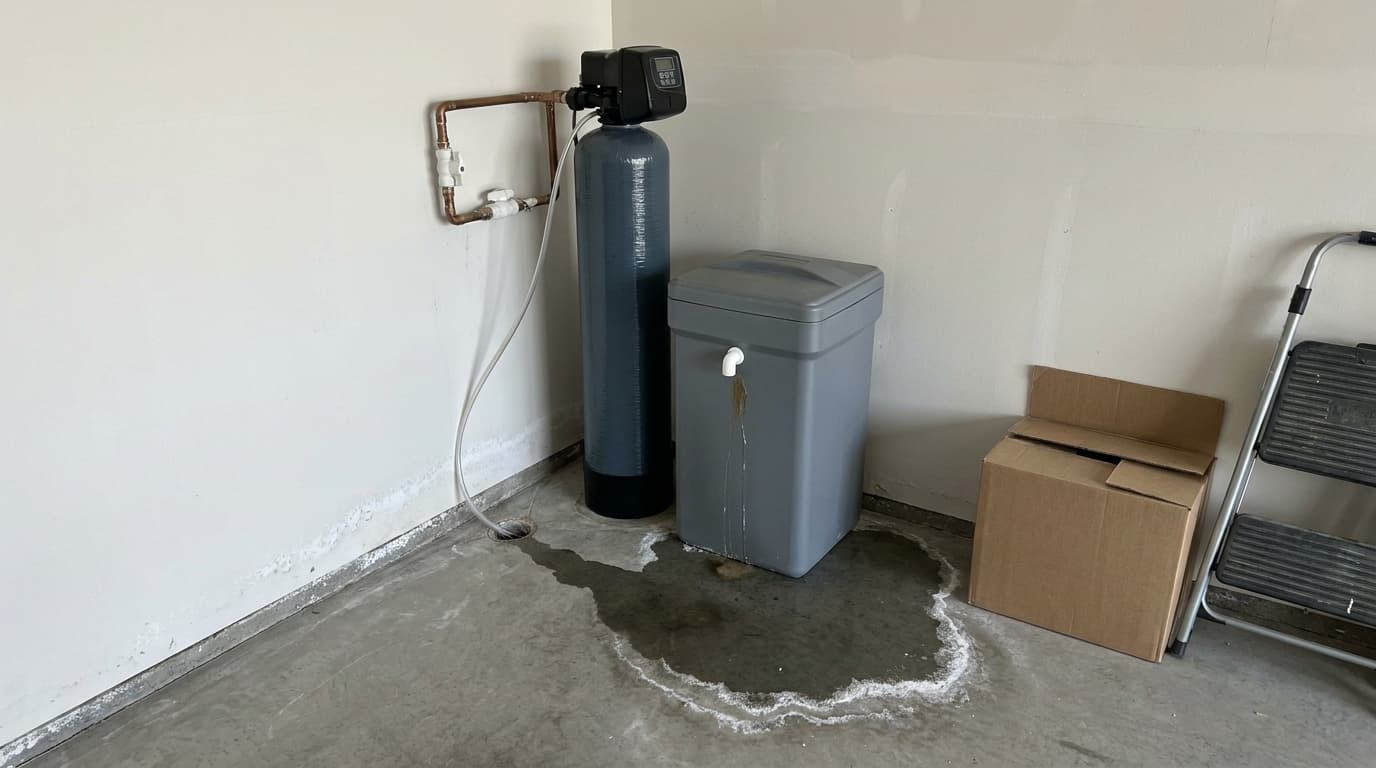
You went into the garage for something else and found it: water creeping out from under the softener, or a white crust on the slab around the salt tank. Often, this turns out to be a small repair. A seal or a fitting lets go, the installer or a water-treatment company fixes it, and the floor dries out.
What sets a softener apart from the other appliances in a garage is the salt. The brine tank holds salt dissolved in water, and when a brine leak dries, the water leaves and the salt stays: on the slab, in the bottom of the drywall, in the wood. Along with the water itself, that leftover salt is what can turn a small repair into water damage repair.
For homes on Garden City's own water system, the Garden City Water and Sewer System's 2025 Consumer Confidence Report puts hardness at 170 parts per million, or 10 to 11 grains per gallon, which falls in the "hard" range of 121 to 180 milligrams per liter on the U.S. Geological Survey's scale (the report defines a part per million as a milligram per liter). Water that hard is what a softener is for. If a different company bills you for water, check that company's report instead.
If water is spreading right now, go straight to the shutoff steps in the section on which leaks to stop yourself.
Get Your Quote
Ready to handle this with a pro?
You're reading about How Do You Find Where a Garden City Water Softener Is Leaking. Get a fast quote for water damage restoration service in Boise, ID from Apex Restoration.
How Do You Find Where a Garden City Water Softener Is Leaking?
Look first and touch nothing yet, least of all the softener's outlet, cord or power adapter if any of them is wet or you're standing in water. The section on stopping a leak deals with the power.
A typical home softener has a tall resin tank with the control valve on top and a shorter brine tank for the salt, sometimes inside one cabinet. A bypass assembly at the back connects the valve to the house plumbing, a drain line runs to a floor drain or standpipe, and the brine tank may have a small overflow fitting. Those are the places to check: the valve, the bypass, the overflow, the brine tank itself, the drain line and the resin tank.
Then read the water:
The highest wet spot matters most. A drip at the valve can run down the resin tank and collect at its base.
The floor tells you more. A white, crusty ring around the salt tank points toward brine. A clean trail down the resin tank points toward the valve and its connections.
The drain line can leak anywhere along its run, including where it ends.
The neighbors count, too. A water heater, a washer hose or a sweating cold pipe can all put water beside a softener.
If the trail leads to a water heater, our guide to what to do first when a water heater leaks covers it. If you can't see the source from where you stand, stop there: shut the water off with the steps below and let whoever services the softener take it apart.
What Tells a Brine Tank Overflow Apart From a Fitting Leak in Garden City?
Three things: where the water starts, when it shows up and what it leaves behind.
A fitting leak starts at the bypass or the pipe connections. Those carry the house's own water, hard or softened, not brine, and they're under the house's water pressure, so the leak tends to keep going and the wet trail starts high. The control valve is the in-between case: it handles house water in service and brine while the softener regenerates, so a leak there can be either.
A brine tank overflow starts at the salt tank. Water coming out of the overflow fitting means the tank has filled higher than it should, and if no drain hose is attached to that fitting, the water ends up on the floor.
Timing is the second tell. The brine tank and the drain line do their work when the softener regenerates, flushing its resin with brine and sending the rinse water down the drain line. Overflows and drain-line leaks tend to show up around that cycle, not while someone is showering.
The residue is the third. Brine is salt dissolved in water, so an overflow or a drain-line leak can dry to a white crust on the slab, at the tank's base or on the wall behind it. Hard tap water can leave spots too, so note where a crust sits, not just its color.
Why a brine tank overfills, salt bridging, the salt you buy and the service schedule are all questions for the installer or a water-treatment company.
How Long Can a Garden City Softener Leak Run Before You Notice?
It can run for a while, because of when it happens and where the softener sits.
The University of Nebraska–Lincoln Extension's general guide to water softening says timer-controlled softeners generally regenerate during periods of low water use, "such as between midnight and 4 a.m.," and that how often a softener regenerates depends on the water's hardness, how much water the household uses, the size of the softener and the capacity of its resin. So an overflow or drain-line leak tied to that cycle is likely to start while the house is asleep, may not repeat every night, and can dry between cycles, leaving nothing on the slab but salt.
Forum threads describe the same pattern. In one, a homeowner asked about what looked like salt build-up around the base of a softener, and a commenter diagnosed a brine tank leaking "slow enough to where you never see it wet."
A softener in a garage or utility room you rarely walk through, behind stored boxes, gets few chances to be seen, and even a steady fitting leak can go unnoticed there.
Two habits help: look around the tanks whenever you add salt, and consider a battery-powered water alarm on the floor beside the brine tank.
Get Your Quote
Ready to handle this with a pro?
You're reading about Where Should You Look for Salt Damage in Garden City Drywall After a Leak. Get a fast quote for water damage restoration service in Boise, ID from Apex Restoration.
Where Should You Look for Salt Damage in Garden City Drywall After a Leak?
Low and close to the softener: the drywall behind and beside the tanks, the baseboard, and the joint where the wall meets the slab, starting with any wall the tanks sit against.
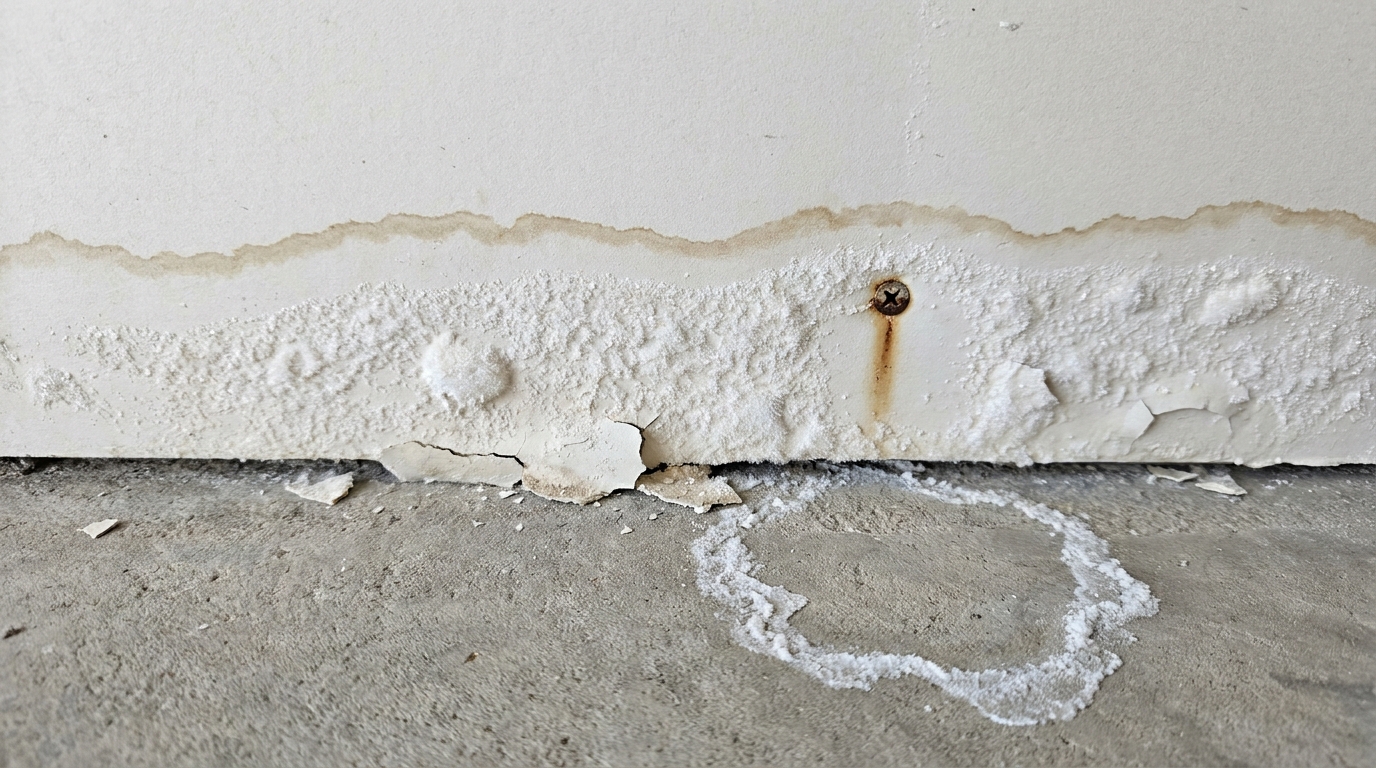
Salt damage doesn't look like an ordinary water stain. When salty water dries, the salt can crystallize at the surface as a white, powdery or crusty bloom called efflorescence, and the National Park Service's guide to controlling moisture in historic buildings lists efflorescence ("salt deposits") on interior surfaces, along with flaking paint, moisture blisters, and rust and corrosion stains on metal, among the common signs of moisture damage. On a garage or utility-room wall, look for:
a white crust or powder on the paint or along the bottom edge
paint that bubbles, blisters or flakes
rust spots or streaks at screw and nail heads
a soft, crumbling bottom edge or face paper peeling away
Whether a wet board can stay is a separate call. The Gypsum Association's guidance on water-damaged drywall (GA-231, cited here from its 2019 edition) says to replace it unless all four of these hold: the water's source has been identified and eliminated; the water was uncontaminated; the board can be dried thoroughly before mold growth begins, typically 24 to 48 hours depending on environmental conditions; and the board is structurally sound, with no rusting fasteners, paper delamination or other physical damage. If there is ever doubt, it says, replace it.
That guidance doesn't say whether softener brine counts as contaminated, so that condition is a judgment call for whoever inspects the wall. Rusting fasteners are on the list either way.
Why Does Salt-Soaked Garden City Framing Stay Damp After It Looks Dry?
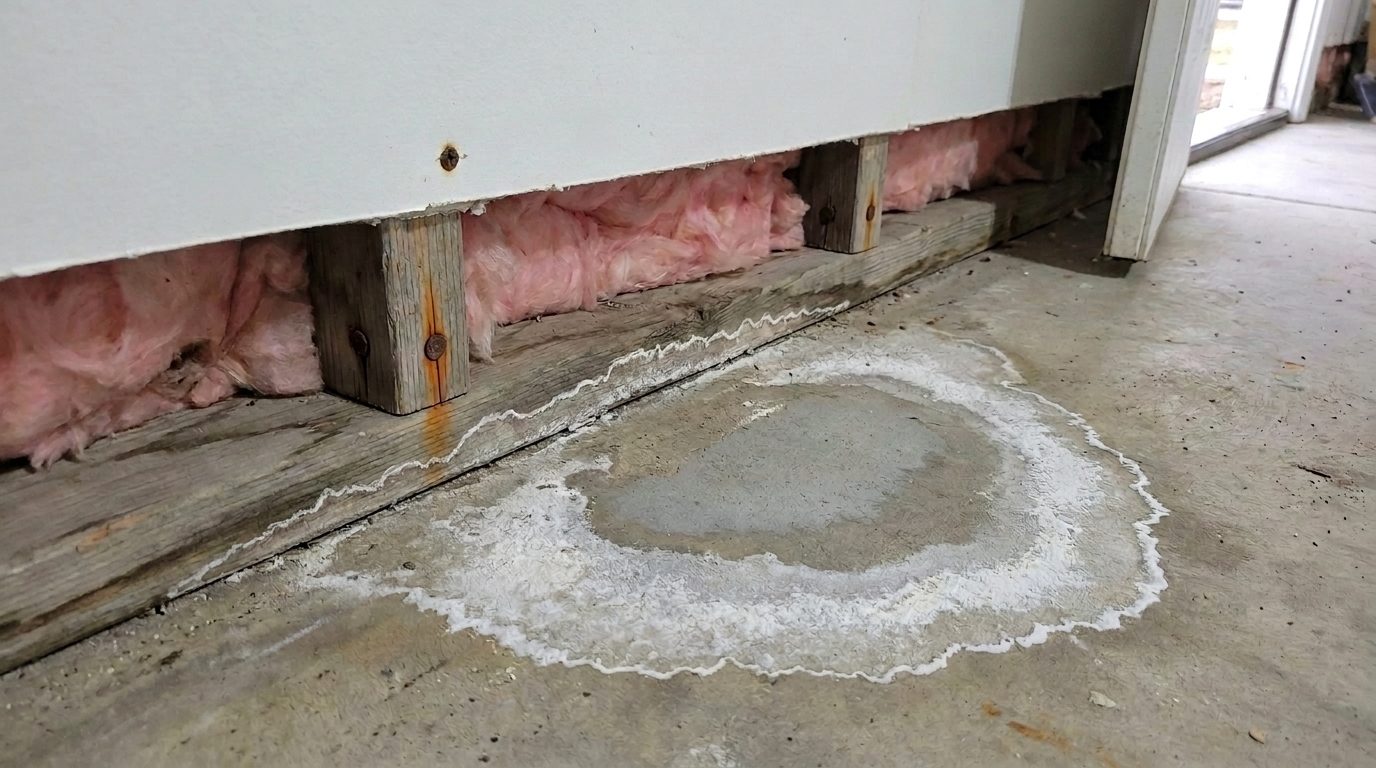
Because drying removes the water, not the salt. When brine soaks into the bottom plate, the board a framed wall stands on, and the base of the studs, the water can evaporate while the salt stays in the wood. That leftover salt raises three questions.
Can it pull moisture back in? The National Park Service describes that happening in damp masonry walls: the salt crystals left where water evaporates from the wall make the masonry "even more sensitive to additional moisture absorption from the surrounding air." That finding is about brick and stone. We're not aware of an equivalent measurement for brine in framing lumber, so we don't assume wood is the exception, and a salty plate that looks dry on a dry day still needs checking.
What does it do to the metal? FEMA's technical bulletin on metal connectors and fasteners in coastal buildings explains that ocean salt, primarily sodium chloride, accumulates on metal surfaces and speeds up the reactions that cause rust, and that the longer a surface stays damp through the day's humidity swings, the higher the corrosion rate. Softener brine, as the UNL guide notes, is typically sodium chloride too, and a leak that reaches a wall puts it in direct contact with the nails and screws near the bottom. Rust at a screw head is one visible sign.
Can you trust the moisture reading? Not on its own. In a 2018 research note on fastener corrosion and salt damage in a historic ship's timbers, the USDA Forest Products Laboratory cautioned that salt in wood raises its measured moisture content "by an unknown amount." A salty plate can read wetter than it is, so neither one reading nor a glance settles whether it's dry.
What trapped moisture does to joists and subfloor over time is covered in our look at water sitting in a Nampa crawl space. Here, the point is simpler: if brine reached a framed wall, "it feels dry" isn't the finish line.
How Do You Know Which Garden City Softener Leaks to Stop Yourself?
You can stop the water on almost any softener leak. Fixing the leak is a different question.
Power comes before water. FEMA's Ready.gov flood-safety page says not to touch electrical equipment if it is wet or if you are standing in water, and to turn off the electricity if it is safe to do so. If your softener plugs into a wall outlet and the outlet, the cord or its plug-in adapter is wet, or you would have to stand in water to reach them, leave them alone. Switch that circuit off at the breaker panel only if you can reach the panel safely, and otherwise call an electrician.
Then the water. These are GE Appliances' steps for its own softeners:
Unplug the softener, but only if the plug and outlet are dry and you are not standing in water; GE says to unplug before any maintenance or cleaning, to minimize the possibility of electric shock.
Shut off the water at the bypass valve. On GE units it sits at the top rear, is usually white plastic with the supply lines attached, and has "push for bypass" printed on one end. Push that end in so water flows around the softener instead of through it.
No bypass valve? Follow the inlet supply line (on a GE unit, the line on the right as you face the front) to its shutoff valve, and turn that valve clockwise until it stops.
Call the installer or a plumber. If the softener is new, call the installer first; GE says most leaks are the result of installation issues.
Those are GE's steps for GE softeners. Other brands' bypass valves can look and work differently, so follow your model's own instructions or ask whoever installed it.
With the power and water handled, move stored things off the wet floor, photograph the tanks, the floor and the wall before any cleanup, and check whether the overflow fitting has a drain hose. If it doesn't, ask the installer about adding one.
The repair itself, whether it's a seal at the valve, a cracked tank or anything inside the softener, belongs to the installer, a water-treatment company or a plumber. We don't service softeners. Our work starts where the water and the salt got into the floor, the walls or the framing.
Get Your Quote
Ready to handle this with a pro?
You're reading about When Does a Garden City Softener Leak Become a Restoration Job. Get a fast quote for water damage restoration service in Boise, ID from Apex Restoration.
When Does a Garden City Softener Leak Become a Restoration Job?
Many never do. A drip caught early on bare concrete, with nothing else wet, is often just a cleanup and a repair visit.
It becomes our kind of job when water or salt has gotten into the building. These are the signs we'd want to see:
water that ran under flooring, into a cabinet base or behind the tanks, where you can't watch it dry
drywall or baseboard with a white crust, bubbling paint or rust at the fasteners
a wall shared with a finished room, where damage may be on the other side
a leak that repeated through more than one regeneration before anyone found it
wet drywall you aren't sure can stay
If the standing water is more than a few towels can handle, getting that water off the slab comes first. Then our IICRC-certified technicians work out what got wet, what has to come out and what can be dried in place, and we document all of it.
Ask to see the readings behind any recommendation, ours included. In one busy homeowners' forum thread about a restoration quote, the most-upvoted replies were wary of a company that talked about insurance before showing any numbers. With brine involved, also ask how the readings account for the salt.
We won't guess at your coverage. How your policy treats a leak that repeated over time, versus one that happened all at once, is a question for its wording and your agent. Dated photos and the softener repair invoice help either way, and we work directly with carriers and adjusters on the documentation. We cover Garden City and the rest of the Treasure Valley, and we answer 24/7. If you're in Boise, our page on water damage restoration in Boise has the details for your city.
Key Takeaways
Often, a leaking softener is a small repair for the installer, a water-treatment company or a plumber. We don't service softeners.
Handle the power before the water, and leave a wet outlet, cord or adapter alone. GE's shutoff steps are for GE softeners.
A leak at the bypass or pipe connections carries the house's water and tends to keep going, with the wet trail starting high. A brine tank overflow starts at the salt tank and can dry to a white crust.
Timer softeners generally regenerate during low water use, such as overnight, so brine-side leaks are likely to start while the house is asleep.
Look low for salt damage: white crust, bubbling paint and rust at the fasteners.
Drying removes the water, not the salt. Salty framing needs checking even when it looks dry, and one moisture reading on salty wood won't settle it.
When in doubt about wet drywall, replace it.
If salt has already reached a wall in your garage or utility room, that's the point to call us.
Apex Restoration Team
Water Damage & Restoration Specialists
We're the Apex Restoration team — a family-owned, IICRC-certified crew handling water damage, mold, and abatement across Boise, the Treasure Valley, and Eastern Washington & North Idaho. We answer 24/7 and write these guides to help homeowners make calm, informed decisions when water, mold, or hazards show up.
Related Posts
Does Homeowners Insurance Cover Mold Removal in Caldwell?
Homeowners insurance can pay for mold removal in a Caldwell home when the mold traces back to a covered water event, often only up to a limit. Here's how that limit often works, what an adjuster weighs, and what to tell your insurer.
What Should You Do When a Star Garage Floods?
When a water heater or washer floods a Star garage, stay clear of anything electrical the water reached, stop it at the source, and move it away from the house wall. Here's what to check next, and which board Idaho's code calls for when that wall is repaired.
How Do You Find a Water Leak in a Middleton Wall?
A leak inside a Middleton wall can show up in the water bill, a faint running sound or a bubbling paint seam before any stain appears. Here's how to narrow it down, what the City's meter rules mean for you, and when opening the wall makes sense.