
How Do You Find a Water Leak in a Middleton Wall?
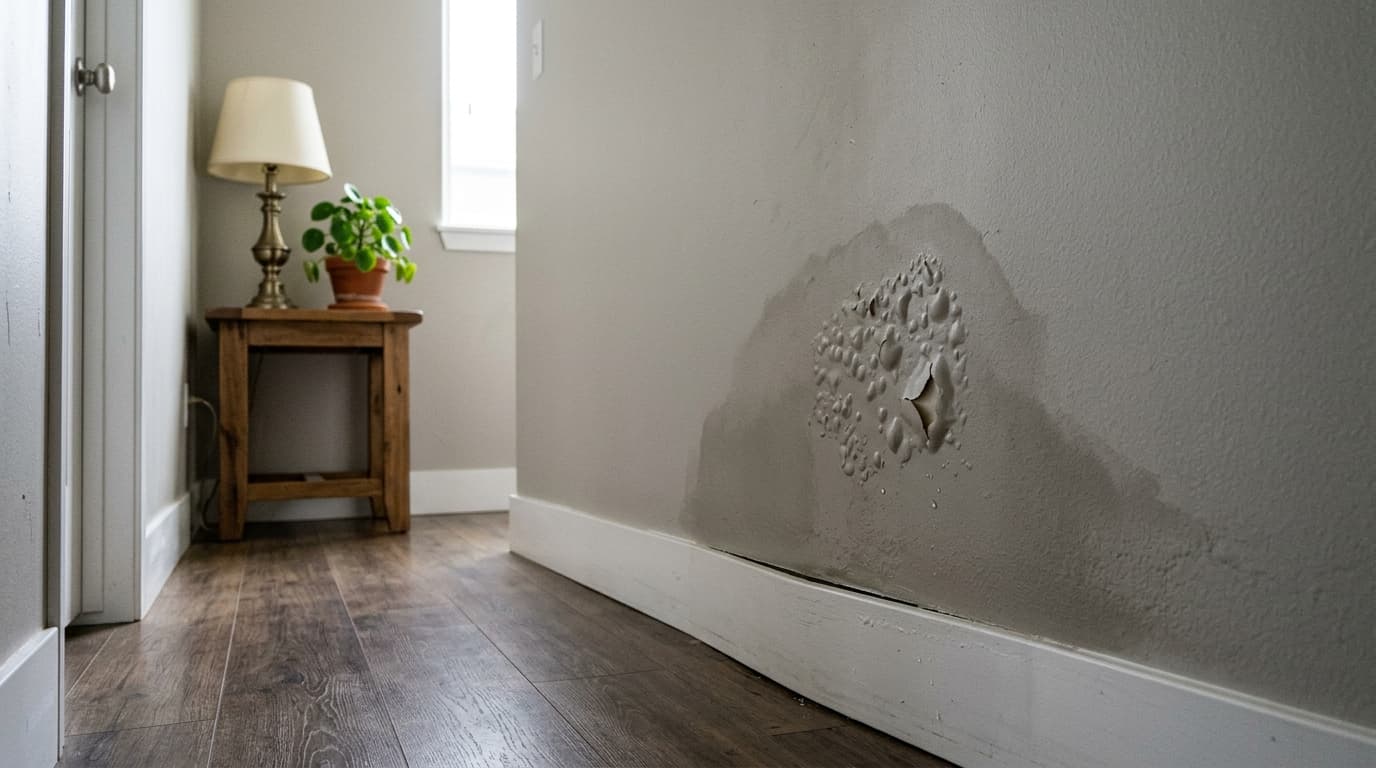
A leak inside a wall doesn't always start with a puddle. It can show up first as a water bill that doesn't add up, a faint running sound in a quiet house, or paint bubbling along a drywall seam. Finding it costs little but time: check the water use, listen, sort a supply leak from a drain leak, and rule out the outside before anyone opens drywall.
Middleton adds a wrinkle at the very first step, so that's where we'll start. Finding and fixing the pipe is a plumber's work. When water has soaked the inside of a wall, drying it out and putting it back together is water damage repair, and that part is ours.
Get Your Quote
Ready to handle this with a pro?
You're reading about How Do You Check a Middleton Water Meter for a Hidden Leak. Get a fast quote for water damage restoration service in Boise, ID from Apex Restoration.
How Do You Check a Middleton Water Meter for a Hidden Leak?
In Middleton, the usual leak check starts with a phone call, not the meter. If your home is on City water, the City of Middleton's utility policies say each connected property's water can and meter are City property, and they make it a misdemeanor to open, tamper with, obstruct or damage a water can or meter, or to turn City water on or off. The policy document is Resolution 508-24, revised in October 2024. So the reading is the City's to take. Call the City's utility billing office, listed on its Utility Information page, say you suspect a hidden leak, and ask how they'd like to handle a meter check.
EPA WaterSense's advice for the check itself is to check your water meter before and after a two-hour period when no water is being used. If the meter changes at all, you probably have a leak. Your part is making sure no water is being used: no showers or flushes, no dishwasher or washer running, the ice maker turned off, the water softener not regenerating, and any sprinkler timer on City water switched off.
The bill is entirely yours. A month that jumps with no change in the household is the first clue, and winter bills compare most cleanly because outdoor watering isn't mixed in. The City's utility policies also say the sewer rate is calculated from average water use from November through March, so a supply leak that runs through those months can raise more than your water charge.
A moving meter, or a bill that jumps for no reason, points to water escaping past the meter, but not to where. It could be the buried line to the house, a toilet that runs on its own, an outside faucet or a pipe in a wall. A leaking drain won't show at all. On a private well, there's no City meter or bill, but the listening test still works.
What Does a Leaking Middleton Wall Pipe Sound Like When You Test It?
It can be a steady hiss or rush, or a faint drip or trickle, and household noise hides it easily. So listen under the meter check's condition, with no water in use anywhere, and turn off the TV and anything else that hums. Then walk the walls that carry plumbing: behind and below bathrooms, the kitchen sink wall, the laundry wall and the wall nearest the water heater. Put an ear flat to the drywall; a stethoscope can help you place a faint sound.
The sound to chase is one that holds steady while the whole house is idle. Two other sounds fool people. A toilet that refills by itself sounds like running water, and while that's a leak worth fixing, it isn't in the wall. Water rushing down a pipe while someone upstairs showers or drains a tub is what a working drain sounds like. A sound that shows up only while a fixture is in use, with no dampness, bubbling or stain nearby, isn't a reason to open a wall by itself.
How Do You Tell a Supply Line Leak From a Drain Leak in a Middleton Wall?
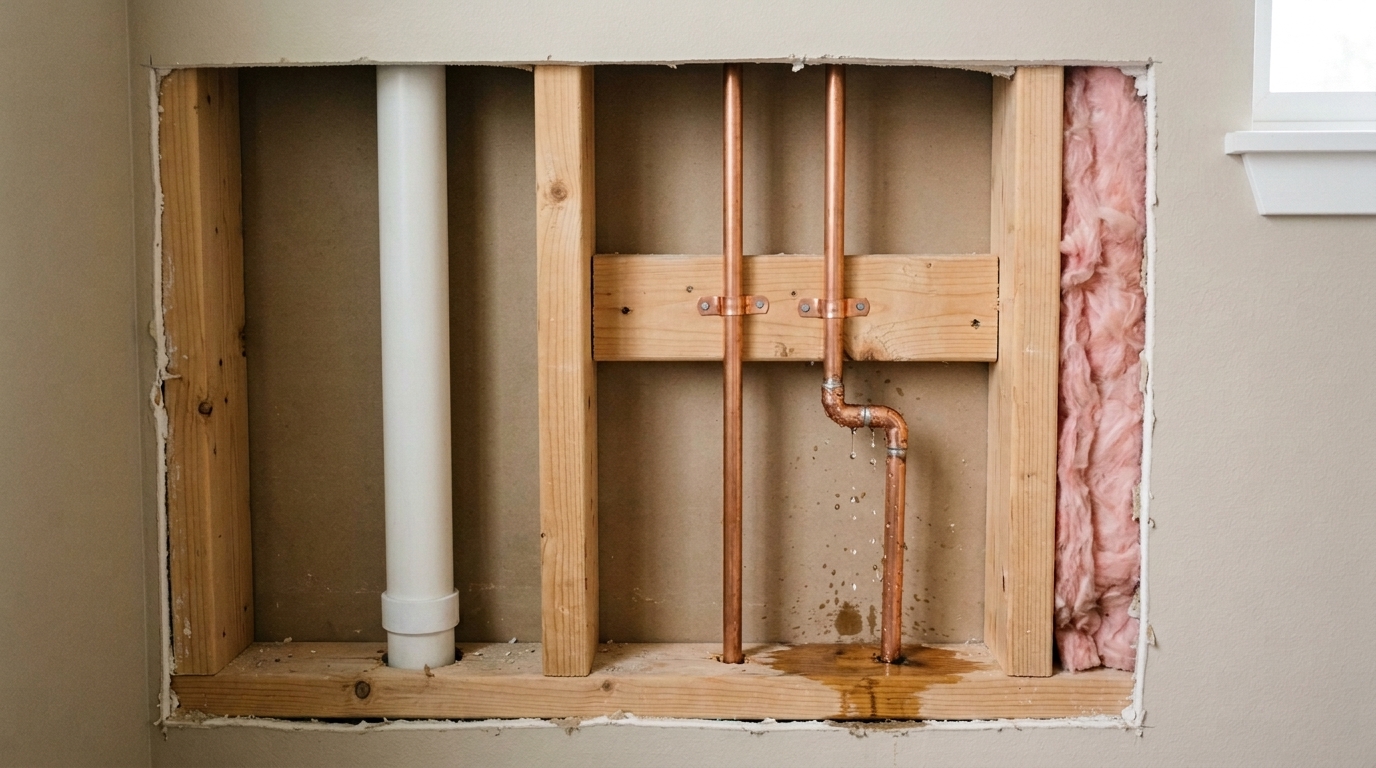
Mostly by when it happens. Supply lines bring water into the house under pressure, and that pressure is there whether or not anyone is using water, so a supply leak keeps going until someone closes a valve or the pipe is fixed. Drain lines carry water away only when something drains, so a drain leak adds water only when a fixture that drains through that pipe is used, and it can go quiet in between.
That difference shows up in the other checks:
The meter and the bill. A supply leak moves the meter while the house is idle. A drain leak doesn't, because nothing flows through the drain during a no-use check. A meter that stays put makes a supply leak less likely, but it says nothing about the drains.
The sound. A supply leak can be heard with everything idle. A drain leak, if you hear it at all, shows up while a fixture is draining.
The dampness. Wetness from a supply leak tends to stay or spread whatever is in use. Wetness that appears after one fixture runs points to that fixture's drain, so running fixtures one at a time and checking the wall after each can find it.
The main valve. With the house idle, a sound or a drip that stops while the water to the house is off, and comes back when it's on, is coming from the pressurized side.
The difference also sets the urgency. A supply leak feeds the wall around the clock. A drain seep adds water only when its fixture runs, so you can often stop using that fixture until a plumber has looked at it. Either way, the repair is a plumber's.
Get Your Quote
Ready to handle this with a pro?
You're reading about Can You Check a Middleton Wall for a Warm Spot From a Leaking Pipe. Get a fast quote for water damage restoration service in Boise, ID from Apex Restoration.
Can You Check a Middleton Wall for a Warm Spot From a Leaking Pipe?
Sometimes, as a clue rather than an answer. A hot-water pipe that isn't leaking cools off between uses, unless the house has a recirculating hot-water system that keeps it warm. One that is leaking keeps drawing hot water from the water heater toward the leak, so the pipe and the wet area around it can stay warm while the rest of the wall sits at room temperature. Thermal-camera maker FLIR says in its guide to finding water leaks that under the right circumstances a thermal camera can find hidden water, and it lists a hot-water pipe leak as one that shows up as a warm area. The same guide notes that the camera sees temperature differences, not moisture, and that a pattern that looks like moisture doesn't guarantee water is there.
Without a camera, wait until nobody has used hot water for a while, then lay a flat hand on the suspect patch and on the same wall well away from it. An infrared thermometer does the same job; the difference between the two spots matters more than either reading. A leak on a cold line, or wet drywall losing water to evaporation, can read cooler instead, which deserves the same attention. A moisture meter can then tell you whether the drywall itself is wet.
Warmth has other causes, too: a heating pipe or duct in the wall, sun on an exterior wall, a water heater or dryer on the other side, or wiring. If the warm spot is an outlet or a switch plate, it's a different problem. The U.S. Consumer Product Safety Commission's Guide to Home Wiring Hazards says switch plates and outlet covers may be warm but should never be hot to the point of being painful to touch or discolored from heat, and that you should stop using one that feels hot right away and get help from a qualified electrician as soon as possible. And a wall with no warm spot isn't cleared, since a small leak may not move enough heat to notice.
Where Should You Check First for a Leak in a Middleton Wall?
Wherever the pipes run: behind and below sinks, tubs, showers and toilets, and behind the washer, the water heater and a refrigerator with an ice-maker line. Water moves down and along framing, so the first sign can appear below the leak or off to one side of it.
In Middleton, what causes most water damage depends on the age of the house, and that changes where to look next. In the original town, it's old supply lines and water heaters, with the damage landing in a basement or dirt crawlspace that dries slowly. In the newer subdivisions, it's crawlspace lines and garage water heaters, with leaks that hide under the floor. So in an older home, check below the suspect wall from the basement or the crawlspace access. In a newer subdivision home, a wall can look fine while water spreads beneath it, so a flashlight look through the crawlspace access is worthwhile.
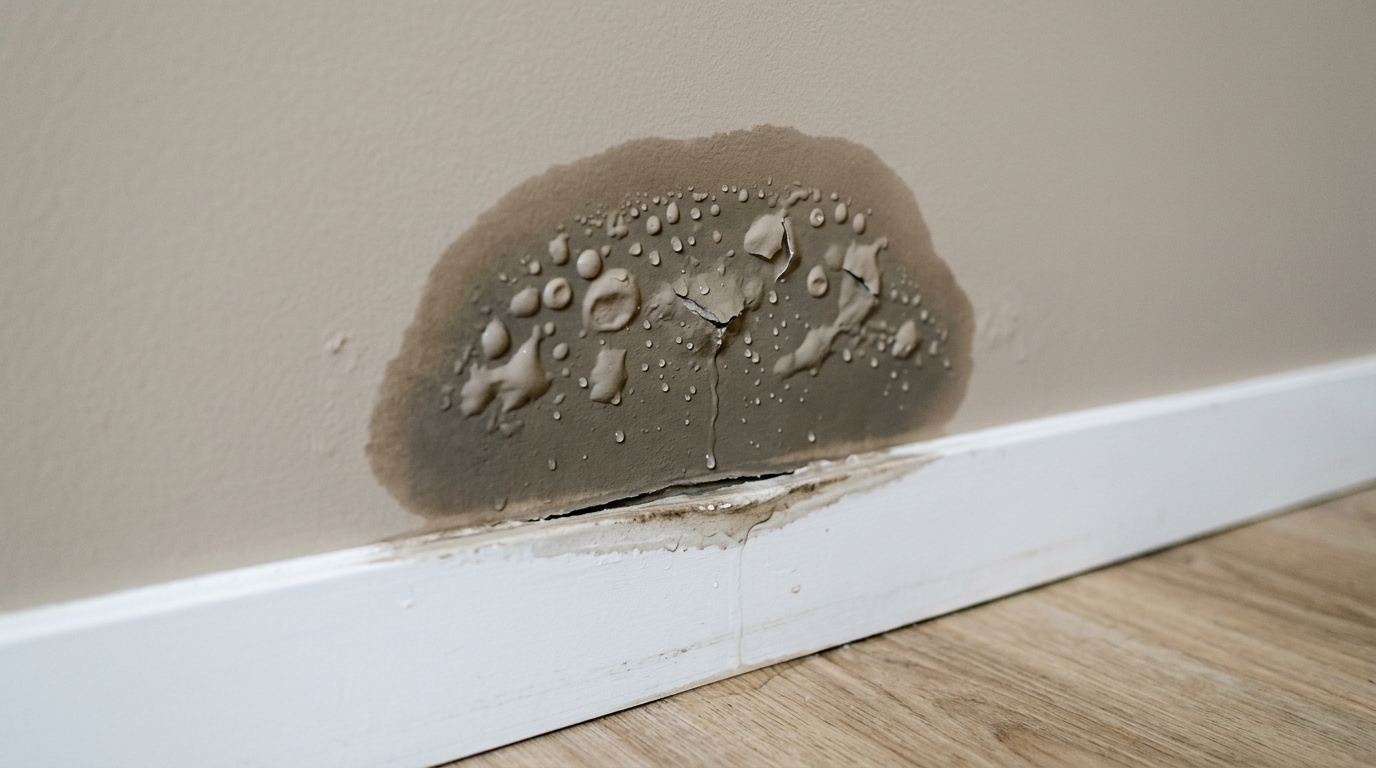
On the wall itself, look for tells that can show up before a stain does: a drywall seam where the paint has bubbled or split along a line, a baseboard that has swollen or pulled away in one spot, or a patch that looks or feels different from the wall around it. If the wall already smells musty or carries a stain, the question shifts to whether there's mold behind the drywall, which our guide on that topic covers.
How Do You Rule Out an Outside Leak Before Opening a Middleton Wall?
Match the dampness to the weather and the water use. If it appears only after rain or snowmelt, look outside: a window or door, the siding, a downspout, or soil sloping toward the house. If it appears only when the sprinklers run, look at the irrigation. If it appears only while an outside faucet is on, look at that faucet. If it's there no matter what, look back inside, at a supply line.
Start with the outside faucets. In one long-running homeowners' thread, the original poster and several commenters each traced a running-water sound inside the house to an outside faucet that hadn't been fully closed, and two of them had been ready to open the drywall. Make sure every outside faucet is fully closed before you go further.
A frost-free faucet can also fail in a way that shows only while it runs. These faucets are built to hold the water back inside the heated part of the house when they're off. Woodford's installation instructions require the water supply connection to be in a heated space for its Model 14 and 17 wall faucets, and warn that a wall faucet that isn't properly installed and operated to drain may freeze and burst in freezing weather. If the section inside the wall has split, water can reach the cavity only while the faucet is open, and that's a repair for a plumber.
Then the irrigation. The City's utility policies say the City doesn't provide irrigation water, and they send residents to their homeowners association or irrigation district for it. So if your sprinklers run on that water, a leaking line or head near the foundation won't move your City meter, and the first check can't catch it. Watch whether the dampness follows the watering schedule, and look for soggy ground or a head spraying the siding. That repair belongs to an irrigation contractor or whoever manages your system, not to us.
Last, soggy ground between the City's meter can and the house can point to the buried water line, which is a question for the City and a plumber, not a reason to open drywall.
Get Your Quote
Ready to handle this with a pro?
You're reading about When Should You Cut Into a Middleton Wall to Stop a Leak. Get a fast quote for water damage restoration service in Boise, ID from Apex Restoration.
When Should You Cut Into a Middleton Wall to Stop a Leak?
Cutting a hole doesn't stop a leak; shutting off the water does. Opening the wall makes sense once your checks show water escaping, point to one stretch of wall and rule out the outside. From there, more guessing tends to cost more than opening, because an active leak keeps wetting the framing and insulation, and a closed wall dries slowly even after the water is off.
A few things come first. Shut the water off at your home's own main shutoff valve, not at the City's meter can, since the City's policies make it a misdemeanor to open a water can or to turn City water on or off. If you can't stop the water from inside, the City's Utility Information page lists an after-hours utility and public works number. If the leak has reached an outlet, a switch or the wiring behind them, have an electrician look before anyone works in that wall. NEMA's guide to evaluating water-damaged electrical equipment, written for floods and other events involving large quantities of water, warns that electrical equipment exposed to water can be extremely hazardous if it's re-energized without a proper evaluation, and says that evaluation should be done by qualified personnel. The wall material matters, too. EPA's asbestos guidance for homeowners says you generally can't tell whether a material contains asbestos by looking at it, that such material may release fibers when it's cut, and that a trained and accredited asbestos professional should take samples for analysis.
A plumber repairs the pipe and opens what they need to reach it. We'd rather a plumber or our crew made the cut than a homeowner with a drywall saw, since the cavity may carry wiring and the pipe sits somewhere behind the board. When water has soaked the insulation, the framing or the back of the drywall, drying out and rebuilding a wet wall is work for our IICRC-certified technicians. If the plumber finds the leak quickly and the wet area is small, you may not need us at all.
Before anything comes out, photograph the wall, the bill that tipped you off and anything the plumber removes. Policies differ on how they treat hidden and long-running leaks, and your policy's wording and your insurer decide what's covered. Our guide to what homeowners insurance tends to cover after a burst pipe walks through the sudden-versus-slow distinction. We work directly with the carrier and the adjuster on the claim and the documentation. Our crews cover the Treasure Valley, including water damage restoration in Caldwell, and we respond 24/7.
In Summary
On City of Middleton water, the water can and meter are City property, and the City's policies make it a misdemeanor to open or tamper with them. Ask the City about a meter check; the bill is yours to read.
A meter that changes at all over a two-hour period when no water is being used probably means a leak.
A sound only while a fixture is in use, with no dampness, bubbling or stain nearby, isn't a reason to open a wall by itself.
A supply leak keeps going whether or not anyone uses water, and it moves the meter. A drain leak shows up when its fixture is used.
A warm or cool patch is a clue, not an answer. Outlet covers and switch plates may be warm but shouldn't be hot; stop using one that feels hot and get help from a qualified electrician.
Rule out outside faucets, rain and irrigation before anyone opens a wall.
Before a cut, shut the water off at your home's own main valve, and have an electrician look if water reached the wiring. A plumber fixes the pipe; drying and rebuilding a soaked wall is our work.
Apex Restoration Team
Water Damage & Restoration Specialists
We're the Apex Restoration team — a family-owned, IICRC-certified crew handling water damage, mold, and abatement across Boise, the Treasure Valley, and Eastern Washington & North Idaho. We answer 24/7 and write these guides to help homeowners make calm, informed decisions when water, mold, or hazards show up.
Related Posts
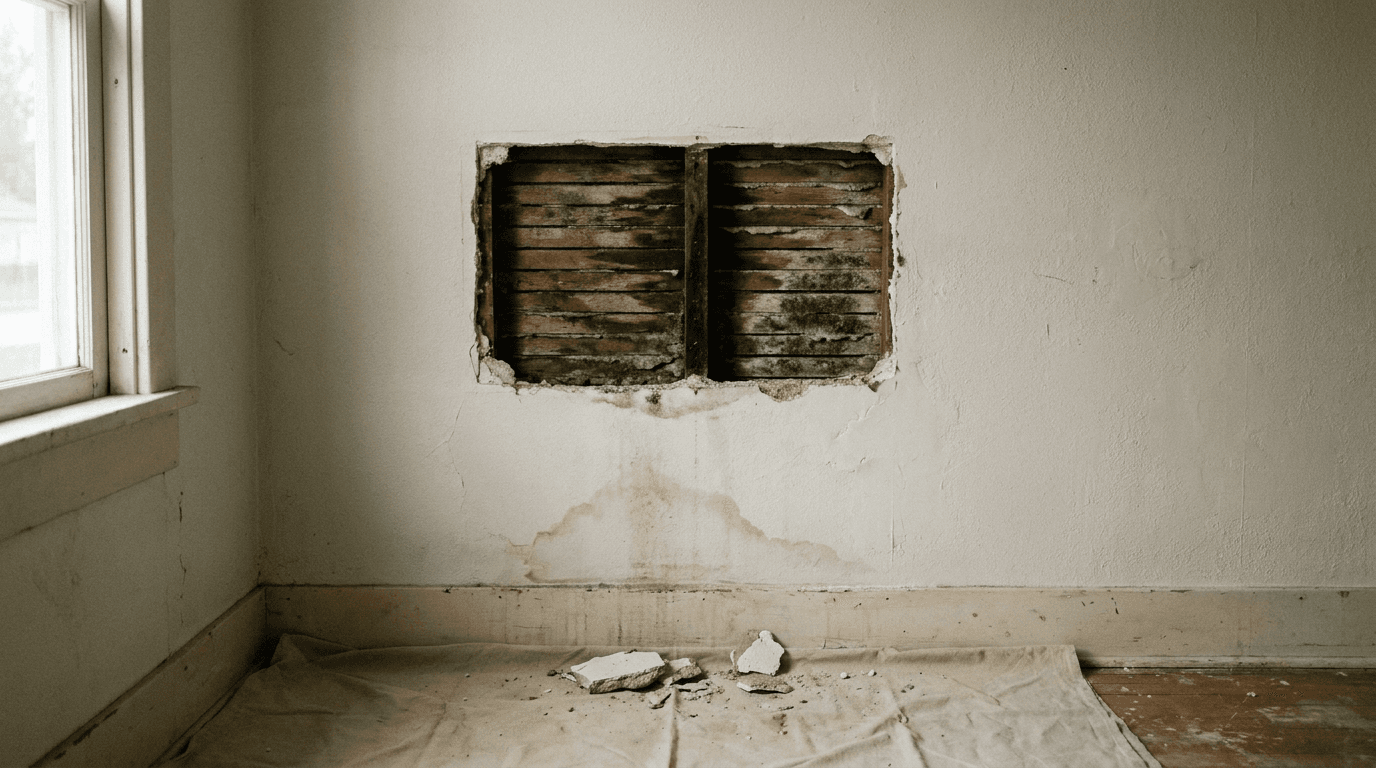
Does Homeowners Insurance Cover Mold Removal in Caldwell?
Homeowners insurance can pay for mold removal in a Caldwell home when the mold traces back to a covered water event, often only up to a limit. Here's how that limit often works, what an adjuster weighs, and what to tell your insurer.
What Should You Do When a Star Garage Floods?
When a water heater or washer floods a Star garage, stay clear of anything electrical the water reached, stop it at the source, and move it away from the house wall. Here's what to check next, and which board Idaho's code calls for when that wall is repaired.
Is Your Garden City Water Softener Leaking Onto the Slab?
A leaking water softener is often a small repair, but brine is salt water, and the salt stays behind when a leak dries. Here is how to trace the leak, stop it safely and spot salt damage in Garden City drywall and framing.