
Water in Your Nampa Crawl Space? How to Find and Fix It

You lifted the crawl space hatch, put a light on it, and there is water down there — a thin sheet across the plastic, or deep enough to throw back a reflection. Emergency, or just what crawl spaces do? In Nampa that depends on when it showed up: after a storm, or after the irrigation system came on.
Two things are true at once. The water needs to come out now, and past a shallow puddle you can safely reach, that is what professional water extraction in Nampa is for. But the water is a result, not a cause. Pump it today without finding the way in and it comes back.
Get Your Quote
Ready to handle this with a pro?
You're reading about How Do You Get Standing Water Out of a Nampa Crawl Space. Get a fast quote for water damage restoration service in Boise, ID from Apex Restoration.
How Do You Get Standing Water Out of a Nampa Crawl Space?
Before anything else, look for electricity. Crawl spaces carry wiring, junction boxes, a furnace or air handler. If standing water touches an outlet, a cord, a panel or any equipment, do not go in. Treat the circuits as live until a qualified person confirms they are off.
Then check whether the source is still running. A supply line, a water heater or an HVAC condensate line can all feed a crawl space, and shutting one off changes the next hour completely. If nothing indoors is running, it came from outside. Photograph everything before you touch it. And decide what the water is before it touches your skin or your shop vac: if it could have come from a drain or sewer line, smells foul, has sat for days, or shows rodent droppings, treat it as contaminated — that is work we do in full protective gear, not bare-handed.
Removal comes down to volume and access. A shallow puddle in a spot you can reach is honest wet-vac work. Anything deeper wants a submersible pump at the low point, discharge run well away from the house — not into the bed against the foundation. Both tools run on electricity in a wet space, so two rules hold: plug into a GFCI-protected outlet, and set the pump before you plug it in — never handle the cord or the pump while you are standing in water. And if the low point is beyond what you can reach from the access opening, stop — crawling through standing water under a house is where we take over.
What defeats homeowners is clearance, not equipment. On a busy homeowner forum thread, a commenter's claim that digging a sump pit takes a few hours was argued down by three others on one ground: you cannot swing a shovel in a space you cannot kneel in.
Water that has been sitting is a different job from water you caught this morning. Once it wicks up into the subfloor and joists, pulling the puddle out is the start of the work, not the end. That is why we push to start extraction same-day.
Where Should You Check First to Find Why a Nampa Crawl Space Keeps Flooding?
Start outside, and start cheap. The most upvoted answer homeowners give each other here is not a system but a sequence: grade sloping away from the house, gutters clear, downspouts moved out.
One field test beats any checklist, and it is free. Wait until the rain or the watering stops, then look again a few days later. Surface water drains. As one drainage contractor put it on video: water still standing days later means the ground itself is saturated.
That matters here because the ground around Nampa gets water on a published schedule. The Nampa and Meridian Irrigation District states it directly: "Depending upon availability of water, systems will turn on approximately 15 April and will shut down approximately the first week of October of each season." A crawl space wet in June and dry in November is telling you something.
The mechanism is documented, with limits worth stating. A 1962 USGS study of irrigation and groundwater in southern Canyon County found that "drainage problems due to the development and rise of shallow perched water tables are likely to occur." That study covered farm ground south of Nampa, not city lots, and says nothing about any particular house. But the mechanism holds: water put on ground like that can collect in a shallow, seasonal layer near the surface — not the deep aquifer, but the one that ends up under a floor. Then work inward:
The HVAC condensate line and drain pan. An air conditioner sheds water all summer, and a line that clogs or discharges under the house runs for months unnoticed.
Supply lines, shutoff valves, and the water heater if it lives down there. A slow drip leaves a wet patch that does not track the weather.
Efflorescence on the perimeter — the white powdery deposit on the first course of block — marking where water moves through the wall.
The exit drain. A crawl space can be graded correctly to a drain that cannot discharge, because the ground outside is already full — which is how a well-built space still floods.
One more pattern, back outside: on a sloped lot the foundation becomes a dam, and the crawl space on the uphill side is the low point.
Is Standing Water Normal in a Nampa Crawl Space, or Do You Need to Fix It?
There is a widely held answer here that deserves a straight response. On a regional homeowner forum in a wet part of the West, the most upvoted comment said the water was fine — that this is what the vapor barrier is for, and it would evaporate as the high water table dropped. That comment carried a forum moderator's flair, not a trade credential.
It is not entirely wrong. Damp soil, a humidity swing, condensation on cold pipes in a space that dries out within days — that is a crawl space behaving normally. But it blurs two things. Moisture in the air is one problem. Bulk water on the ground is another. Air dries. A puddle on plastic under an unheated floor does not.
If you would rather have a standard, there is a federal one. HUD's minimum property standards for crawl spaces state that "the crawl space must not be excessively damp and must not have any water ponding." No allowance for the time of year.
So the line runs between the acute and the chronic. A few puddles right after a storm, gone in a couple of days, is an event. Inches of water, a scum line on the block, or standing water you have stopped noticing is chronic. And locally: if the wet period tracks irrigation rather than a storm, waiting for it to dry out can mean waiting until October.
Get Your Quote
Ready to handle this with a pro?
You're reading about What Does It Take to Dry Out a Wet Nampa Crawl Space and Subfloor. Get a fast quote for water damage restoration service in Boise, ID from Apex Restoration.
What Does It Take to Dry Out a Wet Nampa Crawl Space and Subfloor?
Drying a crawl space has little in common with drying a flooded room. The space is unconditioned, and air does not move through it on its own. The material that matters most sits above your head, in the subfloor and joists — dry-looking from the hatch while the wood is still wet. Our order goes like this:
Bulk water out first. Equipment run over a puddle just moves humid air around.
Saturated material out next. A soaked vapor barrier holds water against the soil, and wet fiberglass batts sag out of the joist bays and never dry in place. When anything shows growth or has been wet more than a couple of days, we pull it wearing respirators and gloves — and anyone with asthma, allergies, or a weakened immune system should stay out of the space altogether.
Then air movement, aimed along the joist bays and across the underside of the subfloor.
Then dehumidification, so water leaving the wood has somewhere to go instead of re-condensing on the next cold surface.
Then verification with a meter. Drying is finished on a reading, not a look — wood that reads dry on the surface can still be wet an inch in.
Time decides whether this stays a drying job or becomes a repair job. The EPA's guide to mold, moisture and your home frames the window as a condition, not a countdown: "If wet or damp materials or areas are dried 24-48 hours after a leak or spill happens, in most cases mold will not grow." That is not a promise mold appears on the third day. It is what drying quickly buys you.
Whether box fans and a rented dehumidifier can finish the job is a fair question, and we answered it for a different room in our guide to what to do after a storm floods a Boise basement. The crawl space version is blunter: a fan pointed into a hatch does not reach the far corner.
Can a Vapor Barrier Stop Moisture From Coming Back Into a Nampa Crawl Space?
Partly — and the part it does not do is the part you are looking at. A vapor barrier stops soil moisture evaporating up into the crawl space air, and it is very good at that. It is not a waterproofing membrane, and it cannot resist liquid water.
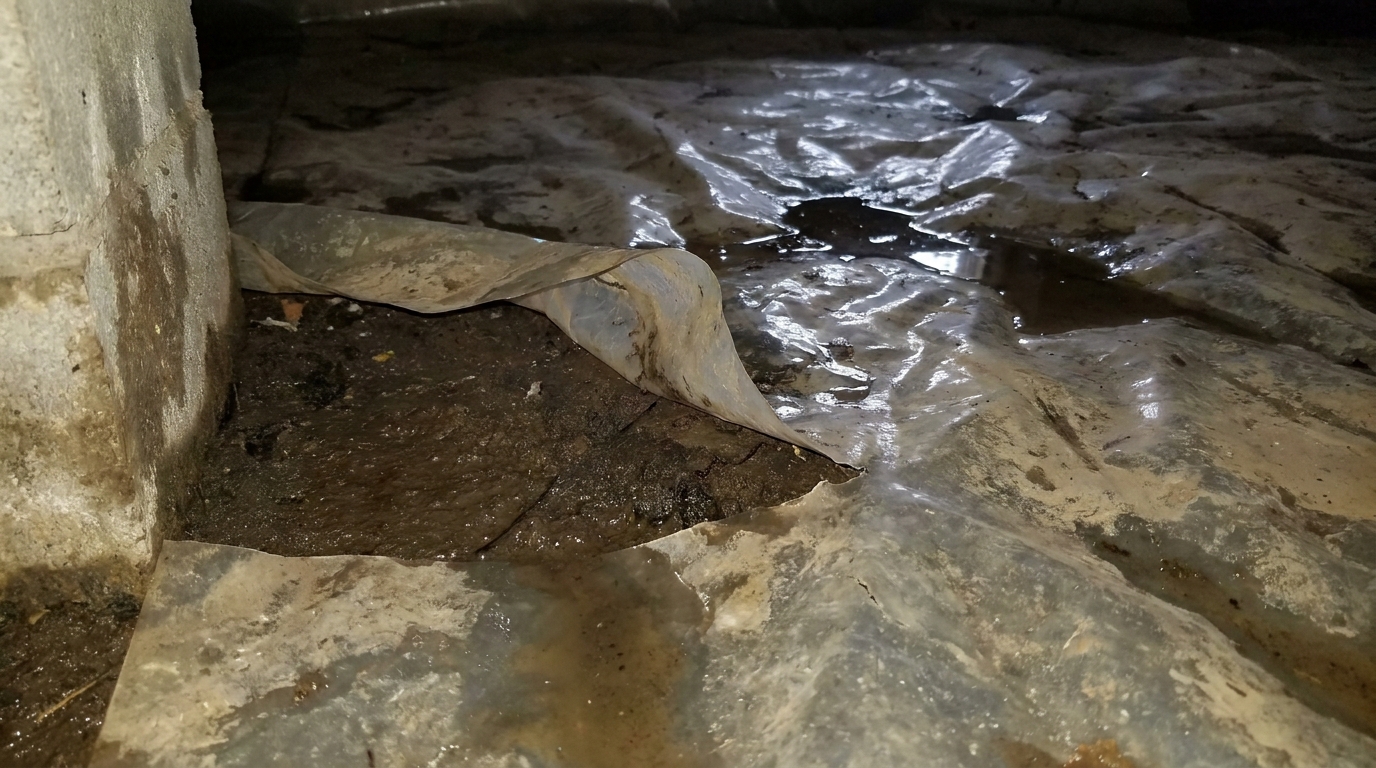
Water sitting on top of the plastic rather than under it. The barrier did not cause this, and it cannot cure it.
Which produces the thing that confuses people most: when bulk water shows up in a crawl space that already has a barrier, it often sits on top of the plastic in a shallow sheet with nowhere to drain — or runs underneath, invisible from the hatch. Neither is a barrier failure.
Plenty of barriers do make things worse: seams never overlapped, plastic short of the walls, tears from a decade of trips down there — each one holding water instead of letting it find the low point.
The sequence matters, and it is the reverse of how this gets sold. Source first: grading, gutters, downspouts, the leaking line. Then drainage, if the water comes out of the ground rather than off the roof. Then the barrier, or a full encapsulation if warranted. Encapsulate ground that is still receiving water and you get a sealed space with water in it.
Two instincts to watch: opening more vents exchanges crawl space air for outdoor air and does nothing about liquid water on the ground. And a crawl space dehumidifier is sized for air, not soil — set one over ground still being recharged and it runs all season without winning.
What Damage Does Trapped Moisture Do to Nampa Crawl Space Joists if You Do Not Fix It?
Most articles assert this part and never explain it: "rot and mold" gets a bullet point. It is actually a staged progression, and knowing your stage is the difference between a cleaning and a repair.
The wood takes on moisture. Framing lumber is built to live dry. You get staining and a smell; nothing structural yet.
Surface growth. Mold and mildew colonize the underside of the subfloor and the faces of the joists, fast on engineered lumber.
Decay. Decay fungi are a different organism, and they consume the wood itself. Here the cost curve turns: strength is being removed, and cleaning does not put it back.
Movement you can feel upstairs. A springy spot, a door that stops latching, a sag along a bearing line. By now the work is carpentry.
The parts nobody wants to reach. Sill plates, beams, and the corroding fasteners and hangers holding the assembly together.
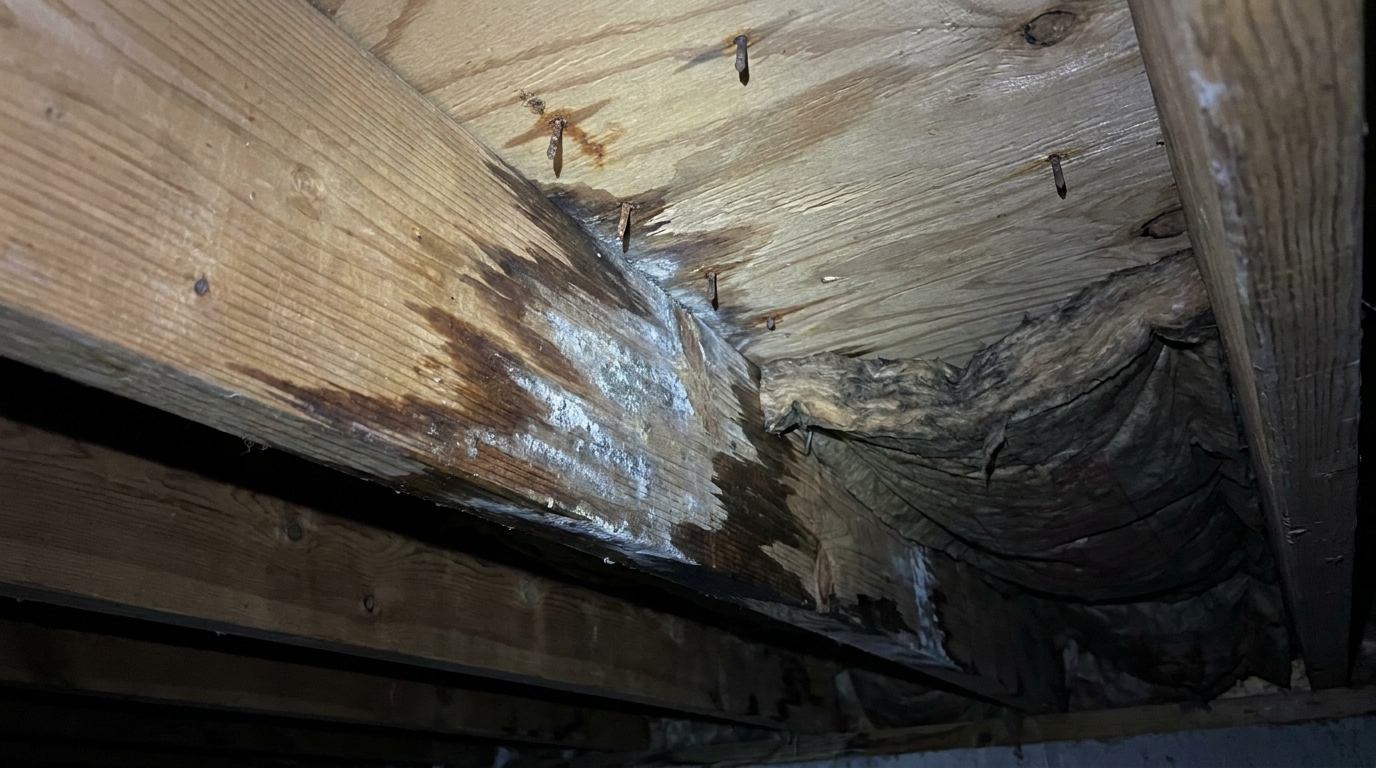
Staining, early surface growth and rust on the fasteners. This is the stage where the bill is still small.
The tells are readable from below once you know them. Insulation sagging out of the joist bays is the one most homeowners walk past — a contractor's crawl space video names it as the sign moisture is still rising into the floor. Rust on nail heads and a musty smell upstairs point the same way.
That last one matters, because a crawl space is not sealed off from the house above it. The EPA's mold course says it directly: "The moisture that accumulates in a crawl space may also enter another part of the building and contribute to mold growth there."
Everything else lives down there too: ductwork, the furnace or air handler, plumbing, sometimes the water heater. Once decay has taken strength out of framing, drying stops and repairing water-damaged joists and subfloor begins. Every stage costs more than the one above it, and the only input that moves a house down the list is time spent wet. For the mold side of the bill, our breakdown of mold removal costs in Boise covers it.
Get Your Quote
Ready to handle this with a pro?
You're reading about Who Should a Nampa Homeowner Hire to Fix a Flooded Crawl Space. Get a fast quote for water damage restoration service in Boise, ID from Apex Restoration.
Who Should a Nampa Homeowner Hire to Fix a Flooded Crawl Space?
The most useful thing we have read on this did not come from a company. A homeowner who solved his own crawl space problem put it this way on a home inspection forum: be careful about making your first call to someone whose income depends on the size of the fix. A structural engineer writes a report with options; a foundation company leads with the biggest one.
That is one homeowner's account, not a professional's — and still a sound instinct, worth repeating even though we are one of the companies you might call. Four different specialties own pieces of this problem:
Water damage restoration is the emergency side: water out, saturated material pulled, the structure dried, the loss documented. That is our lane when there is water down there right now.
A drainage or waterproofing contractor owns the permanent system — exterior drainage, an interior perimeter drain and sump, encapsulation. The right call after the diagnosis, not before.
A plumber, if the source turns out to be a supply line, a drain line or a water heater.
A structural engineer, if a floor is already moving and you want that judgment from someone not bidding the repair.
And genuinely, some of this is homeowner work. Clearing gutters, extending a downspout, regrading the first few feet of soil away from the foundation, vacuuming a shallow puddle you can reach — often the whole fix. Where it stops is access, volume and contamination: anything from the ground or a sewer line, or wood already soft.
Whoever you call, three questions separate a diagnosis from a sales call. What do you think the source is, and what did you look at to decide? What happens if we fix the source and skip the system? How will you verify the wood is dry before closing it up? Our technicians are IICRC-certified, and we work directly with carriers and adjusters on documentation.
If there is water under your floor today, our water damage restoration crews can come look at it, and we cover Caldwell and the rest of Canyon County on the same basis. Whatever you decide about the permanent fix, photograph and date everything before it moves.
The Bottom Line on Water in a Nampa Crawl Space
Water in a crawl space deserves attention without panic. Make it safe first, and assume the circuits are live until proven dead. Get the bulk water out sooner rather than after the weekend, because dwell time is what turns a drying job into a carpentry job.
In Nampa there is one more question a national guide will not ask. Does the wet period line up with a storm, or with the irrigation season? If it is the season, a barrier over ground that is still receiving water only holds the puddle at a different elevation.
If you are looking at standing water under your floor right now and are not sure which you have, that is a normal place to be — worth answering before the wood answers it for you. We are glad to come look.
Apex Restoration Team
Water Damage & Restoration Specialists
We're the Apex Restoration team — a family-owned, IICRC-certified crew handling water damage, mold, and abatement across Boise, the Treasure Valley, and Eastern Washington & North Idaho. We answer 24/7 and write these guides to help homeowners make calm, informed decisions when water, mold, or hazards show up.
Related Posts
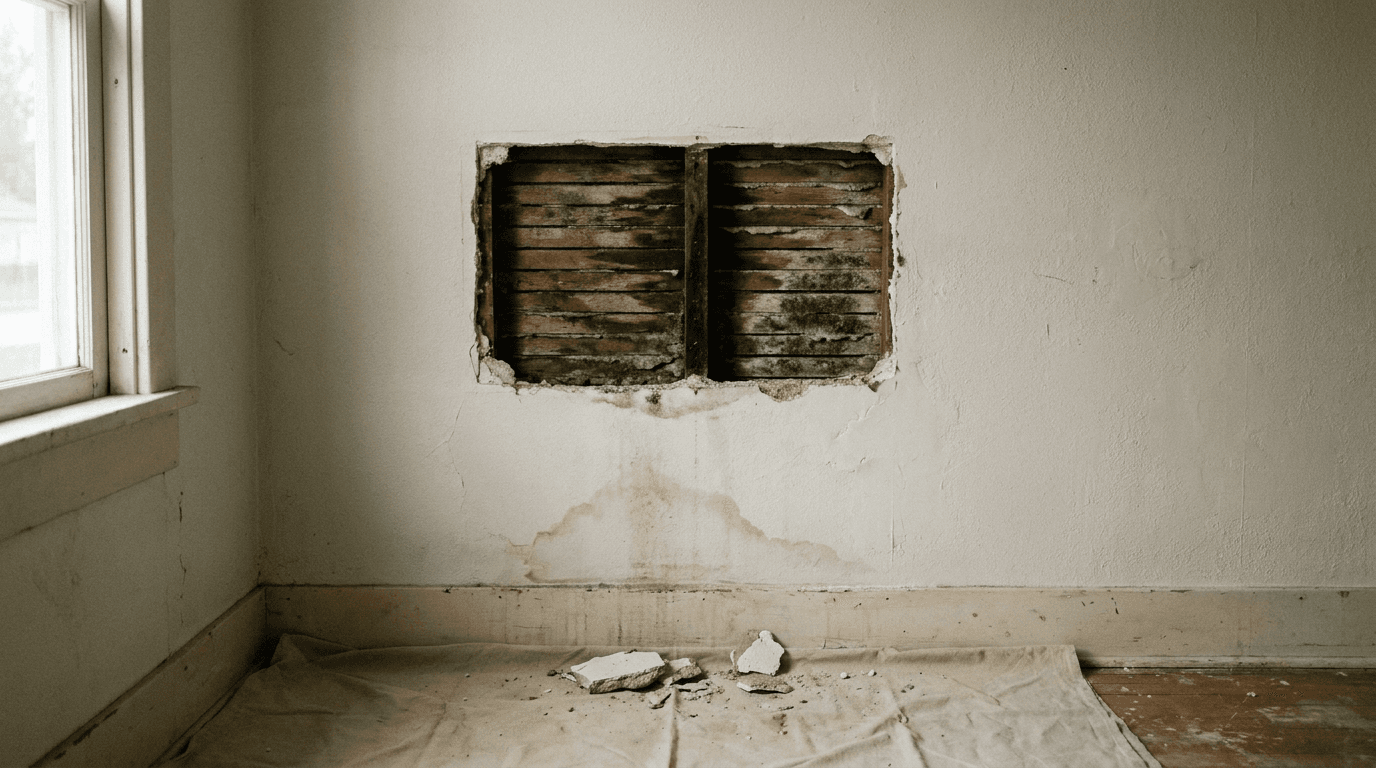
Does Homeowners Insurance Cover Mold Removal in Caldwell?
Homeowners insurance can pay for mold removal in a Caldwell home when the mold traces back to a covered water event, often only up to a limit. Here's how that limit often works, what an adjuster weighs, and what to tell your insurer.
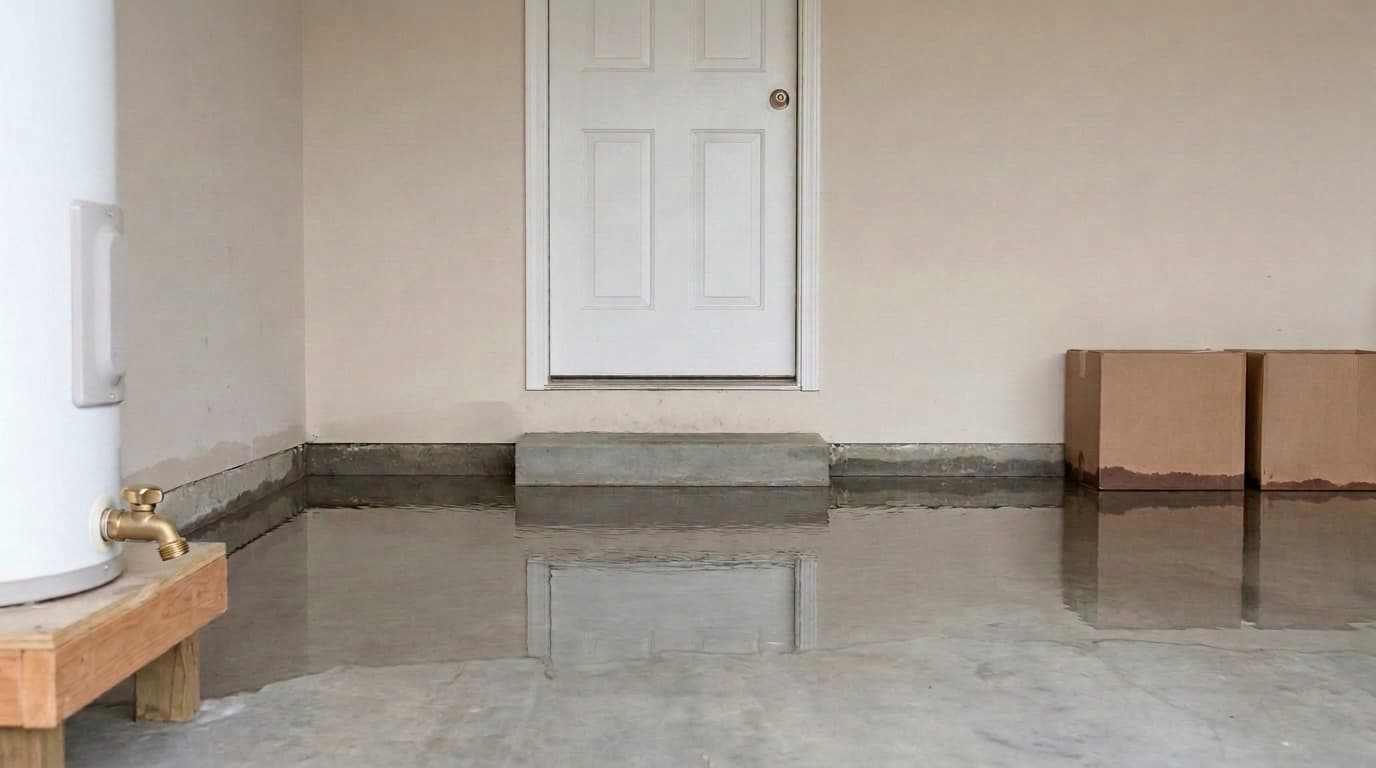
What Should You Do When a Star Garage Floods?
When a water heater or washer floods a Star garage, stay clear of anything electrical the water reached, stop it at the source, and move it away from the house wall. Here's what to check next, and which board Idaho's code calls for when that wall is repaired.
How Do You Find a Water Leak in a Middleton Wall?
A leak inside a Middleton wall can show up in the water bill, a faint running sound or a bubbling paint seam before any stain appears. Here's how to narrow it down, what the City's meter rules mean for you, and when opening the wall makes sense.