
What Should You Do When a Star Garage Floods?
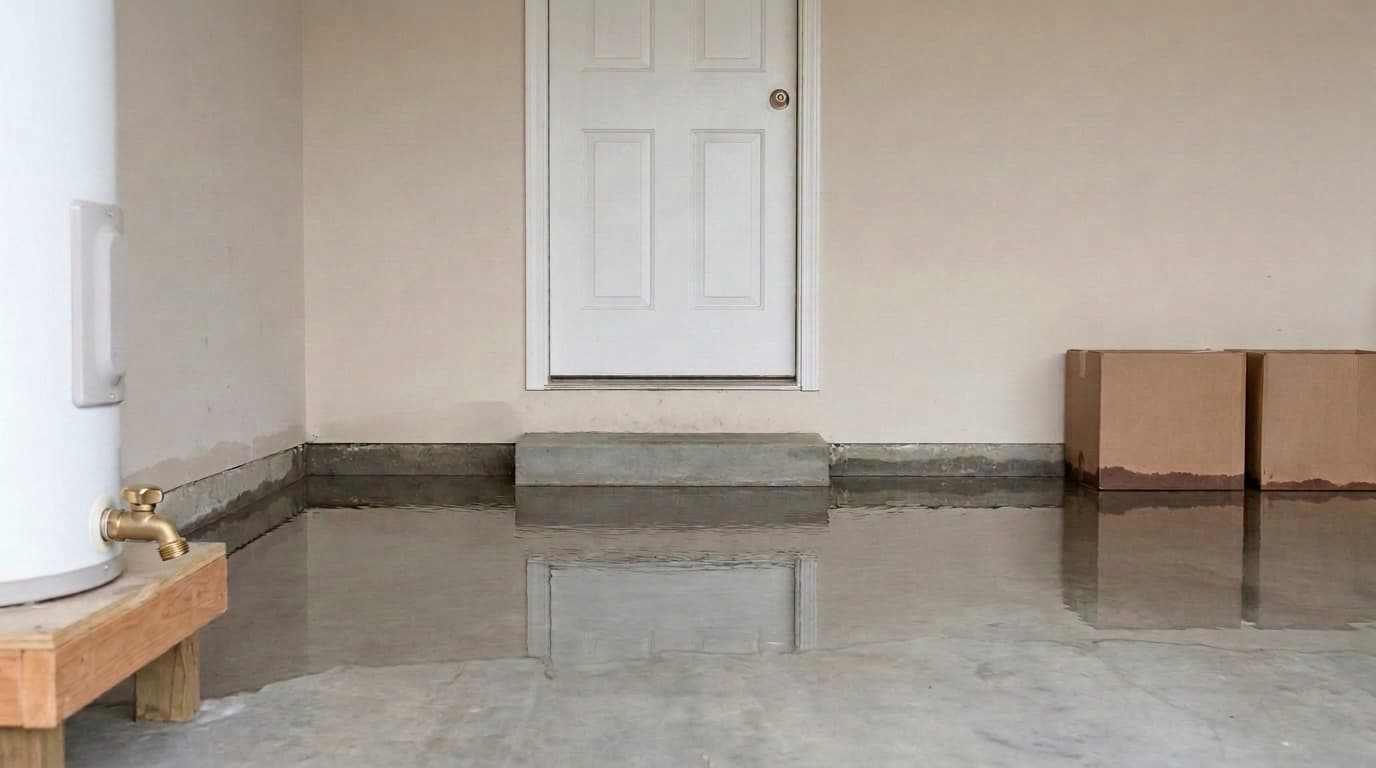
If water from the water heater or the washer is spreading across your Star garage, start with three things, in this order: stay clear of anything electrical the water has reached, stop the water where it starts, and move the water off the slab and away from the wall your garage shares with the house.
The concrete itself usually isn't what needs repair. That shared wall is where a garage spill can become a repair job, and the board that goes back into it isn't a free choice. This guide covers water that started inside the garage, from a water heater, a washer or a supply line. When there's more water than you can pull up yourself, water extraction is where our work starts. If storm water came in from outside instead, begin with what to do in the first 24 hours after storm flooding.
Get Your Quote
Ready to handle this with a pro?
You're reading about How Do You Get Standing Water Off a Flooded Star Garage Slab. Get a fast quote for water damage restoration service in Boise, ID from Apex Restoration.
How Do You Get Standing Water Off a Flooded Star Garage Slab?
Two things come before any squeegee or vacuum: nothing electrical can be in play, and the water has to be stopped.
Settle the electrical question first. The CDC's safety guidelines for reentering a flooded home, written for homes flooded by storms and other disasters, say never to turn power on or off yourself, or use an electric tool or appliance, while standing in water, and to have an electrician turn the power off if reaching the main power switch means entering standing water. We hold a garage spill to the same rule. If your panel is in the garage and the water is between you and it, call an electrician. If the water has reached an outlet, a power strip, an extension cord or a freezer on the floor, the electrician comes before any cleanup. The garage door opener counts too: use the remote, or press its wall button only from dry floor.
Then stop the source. For a water heater, follow the shutoff order in our guide to a leaking water heater, cautions included, since tank water can be hot and the gas or power needs handling too. That guide also covers telling condensation from a real leak. For a washer, close the supply valves behind it, unless reaching them means standing in water next to its plug. In that case, close your home's main water shutoff instead. Repairing whatever failed is a job for a plumber or an appliance technician.
Then move the water. In that CDC guidance, the wet-dry shop vacuum comes after an electrician has determined the power is safe to turn on. In a garage spill that never touched anything electrical, the power was never in question. With the source off:
Open the overhead door and push the water toward it, or toward a floor drain, with a squeegee or push broom.
Put on rubber boots before you run the vacuum on a wet floor, as that CDC guidance advises for operating equipment in wet areas.
Plug the vacuum into a dry outlet away from the water. If that outlet has no GFCI protection, the CPSC's GFCI fact sheet points to portable GFCI units for do-it-yourself work with electric tools.
Set the vacuum up for liquids as its own manual describes. DEWALT's instruction manual for its DXV09P 9-gallon wet/dry vacuum, for example, says not to use it with a damaged cord or plug; not to handle the plug or the vacuum with wet hands; not to pick up gasoline or other flammable liquids, or use the vacuum where they're present; to use only extension cords rated for outdoor use, in good condition, with the connection kept out of liquid; and, when the float shuts off suction, to turn the vacuum off and unplug it before emptying the tank.
If the water smells of fuel or shows a rainbow sheen, don't vacuum it. Leave the door open and leave that cleanup to a crew.
The CDC adds a rule that matters in a garage: never run a gasoline-powered pump's engine inside one, even with the doors open, or less than 20 feet from any door, window or vent. When there's more water than a wet-dry vacuum can keep up with, that calls for professional extraction equipment, not a rented gas pump.
What Stops a Star Garage Flood From Reaching the House Wall?
Very little, once the water is moving. What you control is how much gets out and where it goes.
Look at the base of the wall your garage shares with the house. If the drywall comes down close to the concrete, it takes very little water to reach it. A raised concrete curb or step along that wall buys some margin, but water can still find the threshold of the door into the house or a gap at the base.
The stand isn't a barrier. A water heater on a raised stand or platform can look protected. The stand lifts the tank. It doesn't hold the tank's water, and a failed tank can empty everything it holds onto the slab whatever the stand's height. A platform framed in wood and drywall can also soak up water and hold it against the wall behind it.
What helps:
Shut the water off first. How much comes out decides how far it spreads.
Pull cardboard boxes, rugs and other absorbent things away from the house wall. Soaked cardboard holds water against the bottom of the wall.
Roll a towel along the bottom of the door into the house so less water slips under it.
Speed helps, but it has a limit. Once water has touched the bottom of the drywall, a dry slab doesn't mean a dry wall, so check the wall even after a fast cleanup. For next time, a leak alarm beside the tank and the washer can warn you early, and an automatic shutoff valve can close the water line when its sensor gets wet.
Where Should You Check the Drywall After a Star Garage Flood?
Check both sides of the wall your garage shares with the house, along its whole length, not just beside the appliance. Water can run the length of that wall, so the damage isn't always where the leak was.
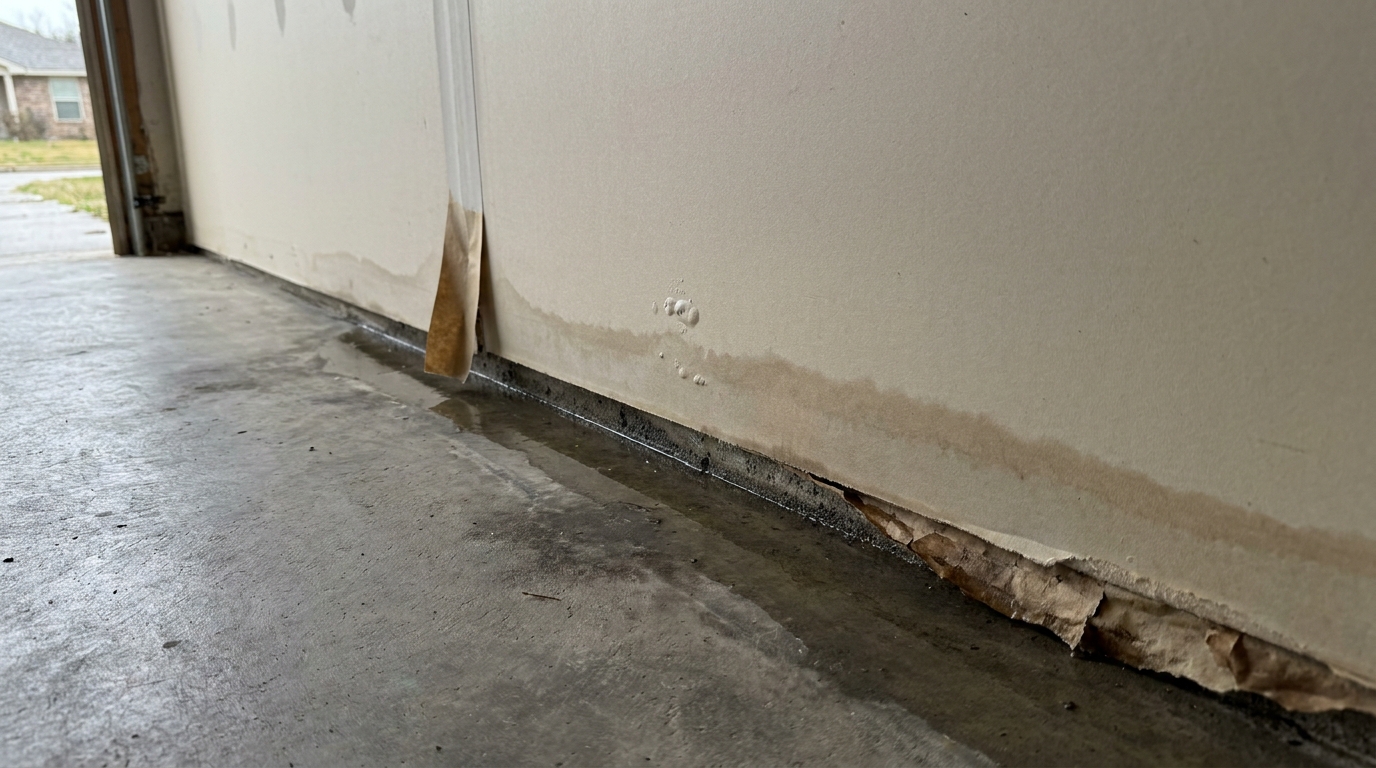
On the garage side, look along the bottom of the wall for:
a darker band just above the floor where the board took on water;
a bottom edge that feels soft, crumbles or gives when you press it;
joint tape that has loosened or lifted near the floor;
paint or texture that has blistered or flaked at the base.
Then check where water hides in a garage: behind shelving and bins against that wall, inside a boxed-in water heater platform, and where pipes pass through the wall.
Now go inside. In the room behind that wall, whether it's a laundry room, a mudroom, a hallway or a closet, look for baseboard that has swollen or pulled away, flooring that has cupped or darkened along the wall, and carpet that feels damp at the edge. Check the door into the house too. The bottoms of its jambs and the trim beside the threshold sit where water can collect.
A musty smell in that room over the next few days is worth taking seriously. And a look only confirms what you can see. To know how far water went inside the wall, it has to be measured with a moisture meter on both faces, or opened.
Get Your Quote
Ready to handle this with a pro?
You're reading about Why Does a Soaked Star Garage Wall Need a Code-Matched Drywall Repair. Get a fast quote for water damage restoration service in Boise, ID from Apex Restoration.
Why Does a Soaked Star Garage Wall Need a Code-Matched Drywall Repair?
Because the wall between your garage and your house has a job the code spells out. People often call it the garage firewall. The International Residential Code covers it in Section R302.6, titled "Dwelling-garage fire separation," and the table in that section specifies the board. When the bottom of the wall comes out, what goes back should match the table, not whatever board is left over from another project.
The Idaho table. The City of Star's Building Department lists the 2018 International Residential Code, with Idaho's amendments, as the city's adopted residential code. One of those amendments, in Idaho's building code rules (IDAPA 24.39.30), deletes the code's Table R302.6 and replaces it with Idaho's own. For the separation from the residence, from attics and from habitable rooms above the garage, Idaho's table calls for not less than 5/8-inch Type X gypsum board, or equivalent, applied to the garage side. In a flooded garage, that usually means the bottom of the wall you share with the house.
If you've read that this wall needs only 1/2-inch board, that figure comes from the model code. The International Code Council's 2021 edition of the IRC calls for not less than 1/2-inch gypsum board on the garage side of the separation from the residence and attics, and saves 5/8-inch Type X for habitable rooms above the garage. On a Star home, start from Idaho's replacement table and its 5/8-inch Type X, not the model code's 1/2-inch figure.
Who decides. The building department that issues permits for your address has the final word on what the repair must meet, and on whether it needs a permit or an inspection. Inside city limits, that's the City of Star's Building Department. If your Star address is outside city limits, a county office may handle it instead, and Star reaches into both Ada and Canyon counties, so ask which one covers you. Some places also amend the code locally, and the building department is the authority on that too. Whoever closes the wall, ask which board is going back before it goes up.
Can You Dry the Framing Behind a Flooded Star Garage Wall?
In many cases the framing can be dried in place, if it's reached early. But it can't be judged through wet drywall, and it shouldn't be guessed at. The first wood the water reaches is the bottom plate the studs stand on, and if the wall has insulation in it, that needs checking too. None of it is visible from the garage.
Time is the reason not to wait. EPA's A Brief Guide to Mold, Moisture and Your Home says that if wet materials are dried within 24 to 48 hours of a leak or spill, in most cases mold will not grow. A closed wall dries slowly, and this one has living space on its other side.
That's why, when moisture readings show water inside the wall, we open the bottom of the garage-side board rather than wait on it. With the wall open, the plate, the studs and any insulation can be checked directly, wet insulation can come out, and air can reach the wood. The board that comes off is the one Idaho's table covers, so the opening should be closed with the board described above.
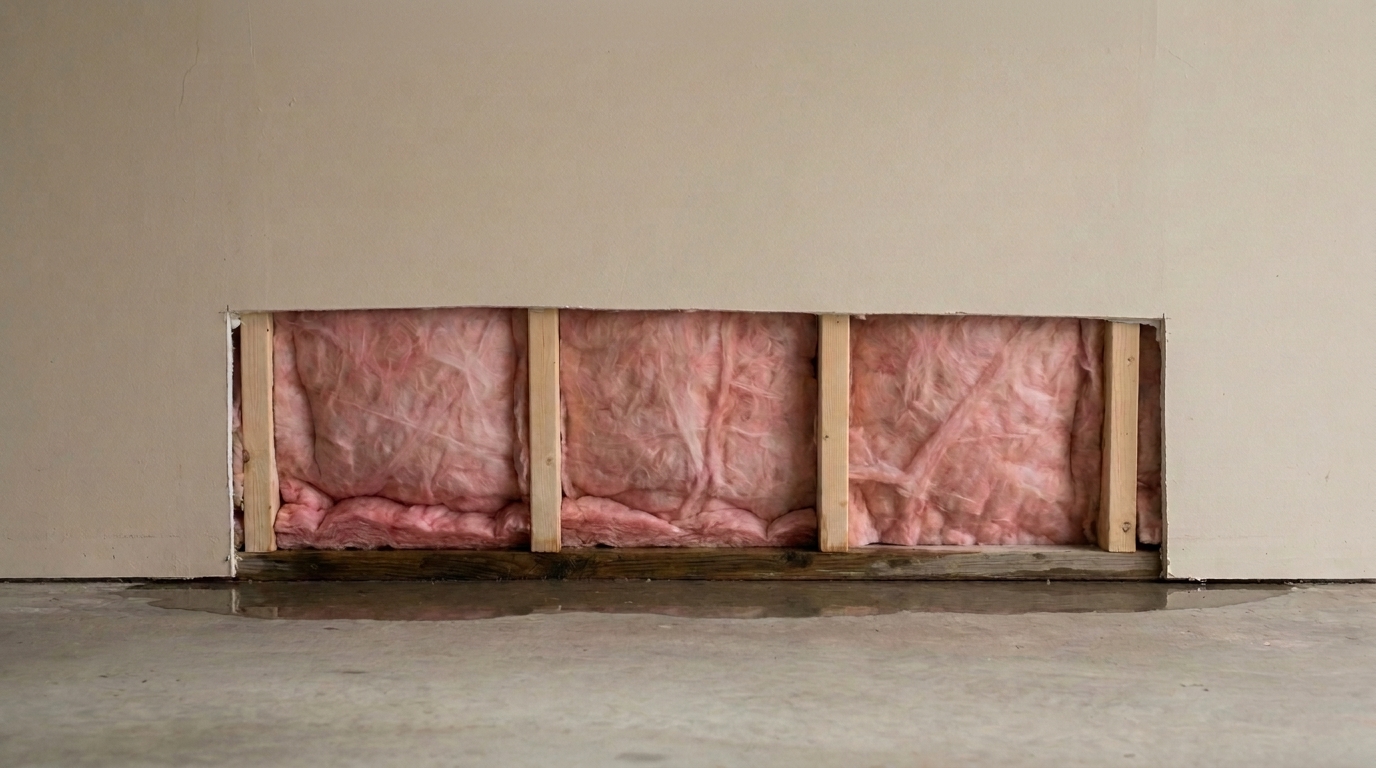
Whoever does the work, the wall shouldn't be closed until the framing measures dry. If you're wondering whether household equipment can get it there, our basement flooding guide covers whether fans and a dehumidifier are enough.
Which Star Garage Flooding Can You Clean Up Yourself?
A small spill of clean water that stayed on the concrete is usually yours to handle, using the steps above. It's a do-it-yourself job when all of these are true:
The water came from a supply line or the water heater, not from the washer's drain side.
You saw it happen or know it was brief, and the source is now off.
It never reached the wall you share with the house, the door into the house or anything electrical.
There's no fuel smell or sheen on it.
A wet-dry vacuum can keep up with it.
Washer drain water deserves a second look. It has been through a wash, so we don't treat it as clean water, even when it looks clear. If you can't tell whether the water came from the supply side or the drain side, treat it as drain water.
We'd also leave the wall itself off the do-it-yourself list. Opening it safely and putting it back to Idaho's table are both part of the job, and a patch that uses the wrong board is easy to miss once it's painted.
Get Your Quote
Ready to handle this with a pro?
You're reading about When Should You Hire a Crew to Restore a Flooded Star Garage. Get a fast quote for water damage restoration service in Boise, ID from Apex Restoration.
When Should You Hire a Crew to Restore a Flooded Star Garage?
As soon as any condition on that list fails. Three situations stand out:
The water reached the house. If it touched the shared wall or went under the door into the house, some of the damage is where you can't see it, and the repair runs into Idaho's separation rule.
You don't know how much or how long. A tank that emptied, or a leak you found after a night or a weekend away, has had time to spread and soak in.
The water isn't clean or safe to work in. Washer drain water, a fuel sheen, or water that reached anything electrical changes how the cleanup has to be done.
On a garage call, our IICRC-certified technicians start with extraction, then take moisture readings on both sides of the shared wall, at the door into the house and in any water heater platform. If the wall is wet inside, we open it from the garage side, dry the framing and confirm it by measurement before anything is closed.
If you're thinking about an insurance claim, how the water got out matters. Homeowners policies can treat a sudden failure, a slow leak that ran unnoticed and water that came in from outside in different ways, so check how your own policy words water damage, or ask your agent. We work directly with carriers and adjusters on the documentation.
We take calls 24/7 from Star and the rest of the Treasure Valley, and the same service is on our page for water damage restoration in nearby Eagle.
Quick Recap
Settle the electrical question before anything else. If your panel is in the garage and the water is between you and it, or water reached an outlet, a power strip, an extension cord or a freezer on the floor, an electrician comes first.
Then stop the water. For a water heater, follow the shutoff order in our water heater guide.
Push water toward the open overhead door, then run a wet-dry vacuum in rubber boots, plugged into a dry outlet away from the water. If there's a fuel smell or sheen, skip the vacuum and leave that cleanup to a crew. Don't run a gasoline-powered pump's engine inside the garage, even with the door open, or less than 20 feet from any door, window or vent.
A raised stand doesn't hold back the water a failed tank can release.
Check both sides of the shared wall, the door into the house and any boxed-in water heater platform.
For a Star repair, start from Idaho's table: not less than 5/8-inch Type X gypsum board, or equivalent, on the garage side of the house wall, not the model code's 1/2-inch figure. The building department for your address has the final word.
In many cases, framing can be dried if it's reached early. Don't wait on a wet wall, and don't close it until the framing measures dry.
A small, brief spill of clean water that never touched the wall, the door into the house or anything electrical is usually yours to handle. Water that reached the house, sat unseen, or isn't clean or safe to work in is a job for a crew.
Apex Restoration Team
Water Damage & Restoration Specialists
We're the Apex Restoration team — a family-owned, IICRC-certified crew handling water damage, mold, and abatement across Boise, the Treasure Valley, and Eastern Washington & North Idaho. We answer 24/7 and write these guides to help homeowners make calm, informed decisions when water, mold, or hazards show up.
Related Posts
Does Homeowners Insurance Cover Mold Removal in Caldwell?
Homeowners insurance can pay for mold removal in a Caldwell home when the mold traces back to a covered water event, often only up to a limit. Here's how that limit often works, what an adjuster weighs, and what to tell your insurer.
How Do You Find a Water Leak in a Middleton Wall?
A leak inside a Middleton wall can show up in the water bill, a faint running sound or a bubbling paint seam before any stain appears. Here's how to narrow it down, what the City's meter rules mean for you, and when opening the wall makes sense.
Is Your Garden City Water Softener Leaking Onto the Slab?
A leaking water softener is often a small repair, but brine is salt water, and the salt stays behind when a leak dries. Here is how to trace the leak, stop it safely and spot salt damage in Garden City drywall and framing.