
Water Heater Leaking in Spokane, WA? What to Do First
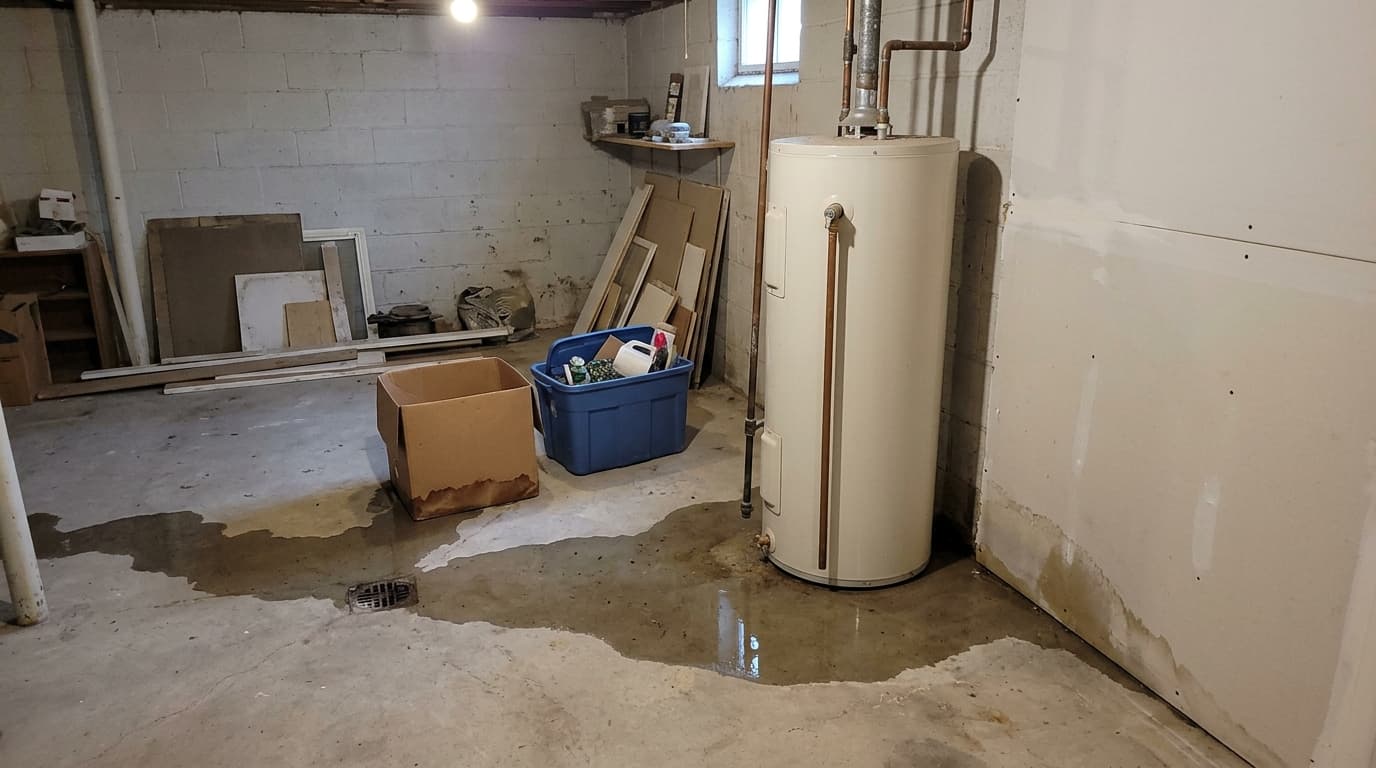
There is water on the floor around your water heater, and you want two things: to make it stop, and to know whether the house still has water tonight. A homeowner on r/Plumbing asked exactly that, and the plumber who answered put it in a single line: "You'll still have cold water." Closing the valve on the cold line into the tank shuts off that tank, not your plumbing — the showers go cold, the taps still run.
The first answer has three parts. Stop the water, cut the gas or the power, then prove where the leak is coming from before anyone buys a part. A fourth part decides how this ends, and most guides skip it: what the water did to the floor and the wall behind it. That is where a slow drip becomes professional water damage repair.
Everything below is written for the ten minutes you are standing in.
Get Your Quote
Ready to handle this with a pro?
You're reading about How Do You Stop a Leaking Water Heater in a Spokane Home. Get a fast quote for water damage restoration service in Boise, ID from Apex Restoration.
How Do You Stop a Leaking Water Heater in a Spokane Home?
Work in this order, and do not let the puddle rush you past step two.
Close the cold-water inlet. First caution before you touch anything: the water in that tank, and anything the relief line is throwing off, can burn on contact. Keep your hands off the hot-side pipe and out of the puddle until you know it has cooled. Then follow the two pipes out of the top of the tank; one has a ball valve or a round handle. Turn it clockwise until it stops. If it is seized, or looks old enough to snap, use the main instead.
Cut the energy. On a gas unit, turn the control knob to OFF and stop there. If you smell gas, skip this step entirely: leave the house and call your gas company from outside. On an electric unit, switch off the water-heater breaker — but only if the panel is dry and you can reach it without walking through water.
Move what the water can ruin. Cardboard, stored boxes, anything on the floor nearby — and photograph the room before you mop.
Leave the draining decision until you have read the safety section below. A hot, full tank under pressure is not something to put a hose on.
Cutting the energy is not a formality. A gas burner firing on a low tank, or an element running dry, adds a hazard the leak by itself would not. As a commenter on r/Plumbing put it, you do not want it to fire with the tank dry.
The rest of the house keeps running, meanwhile — worst case, a few cold showers.
Where Should You Check to Find the Source of a Water Heater Leak in Spokane?
Start by ruling out what is not a leak. A tank that is new, was just refilled, or sits in an unheated garage can sweat — humid air beading on cold metal, like iced tea in July. As jimmy mack puts it, condensation eases as the tank warms while a real leak only worsens. Wipe the unit dry and look again a few hours later.
Water at the base does not mean the tank failed. Water runs downhill, so a drip from a connection on top can travel down the jacket and pool at the bottom. Trace it to the highest wet spot: wipe the unit dry, lay a paper towel at the top fittings, one at the side valve and one at the drain valve, then watch through the cool-down. Do this with the unit already shut down. A tank holds its heat for hours after the gas or the breaker goes off, and that slow cool-down is enough to show the tell: a drip that eases as the metal cools points at the tank itself rather than at a fitting. Never relight a pilot or switch a breaker back on to force heat into the tank for this test. Whichever wets first points at the source.
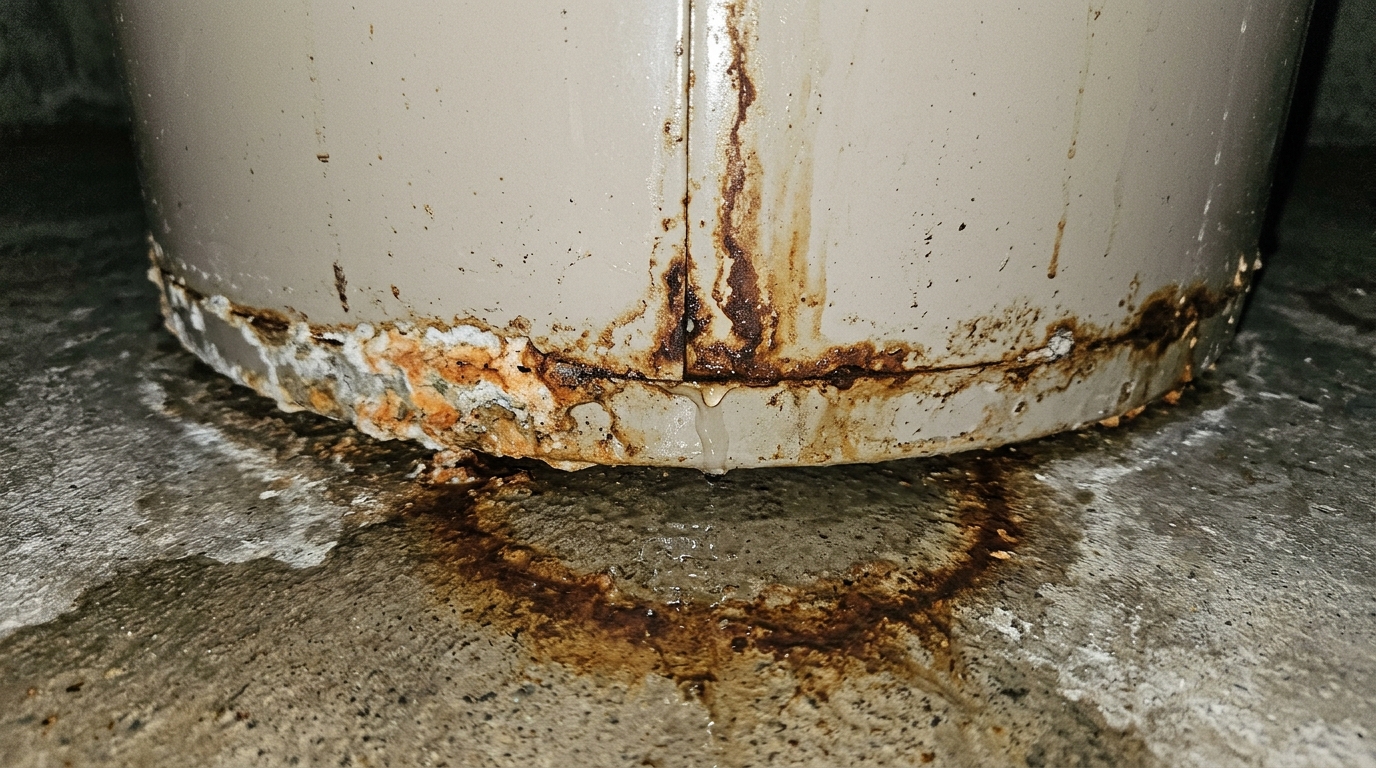
Rust streaking and mineral crust at the base of a tank. Water collecting here may have started at a fitting above and run down the jacket.
One tell you will not find in print comes from Word of Advice TV. Steel expands as it heats and contracts as it cools, so a crack in the tank body changes size with the temperature of the water inside it. That is why the cool-down tells you something: a drip that eases off as a shut-down tank loses its heat is pointing at the tank itself rather than at a fitting. Work down the unit in this order:
The cold inlet and hot outlet fittings and their nipples
The relief valve, at its threads and at the open end of its discharge pipe
The drain valve, and whether a flush left it open
Heating-element gaskets and the anode rod threads on top
The bottom seam, last, because it answers only when everything above is dry
If every fitting and the relief valve test dry, the tank is the source — and as a technician on r/hvacadvice puts it, a bad tank gets replaced, not repaired.
Which Water Heater Leaks Can a Spokane Homeowner Repair Without a Plumber?
The honest list is short, but worth having: the alternative is paying someone to tighten a nut.
A loose threaded connection above the tank. Snug it with a wrench — firmly but not gorilla tight, in jimmy mack's phrasing, because overdoing it cracks fittings.
A drain valve left open after a flush, which closes with a quarter turn.
Condensation, which is not a repair at all.
The relief valve sits right on the line, and it is where homeowners lose money. A heavily upvoted r/Plumbing comment makes the case: before replacing a valve that weeps, check your house water pressure, or the new one weeps too. One commenter on r/Plumbing put the threshold at 80 psi, advising anyone replacing a weeping valve to check the pressure first or watch the new one leak too — a rule of thumb from a discussion thread, not a code citation.
Advice elsewhere routinely tells homeowners to lift the relief valve's test lever. A r/Plumbing commenter has the better rule: if the valve is older than about an hour, look, do not touch, unless a replacement is already in hand.
Where DIY stops entirely is gas. A homeowner on r/HomeImprovement said it in a way worth borrowing — have a pro do that. Turning the control knob to OFF is your job; the burner, the gas control and the pilot are not.
Stopping the water and drying what it soaked are two different jobs — the IICRC S500 standard puts correcting the source on the property owner rather than the restorer, which is why a plumber deals with the valve or the tank while we deal with the building. We have written out the order to work in after a burst pipe in full.
Get Your Quote
Ready to handle this with a pro?
You're reading about Is It Safe to Handle a Leaking Water Heater Tank Yourself in Spokane. Get a fast quote for water damage restoration service in Boise, ID from Apex Restoration.
Is It Safe to Handle a Leaking Water Heater Tank Yourself in Spokane?
Parts of it, yes — but tank water injures on contact, and a discharging relief valve releases that water, not tepid water. The Consumer Product Safety Commission puts numbers on it in its guidance on tap water scalds: most adults suffer third-degree burns after two seconds at 150 degrees, six at 140, or thirty at 130, and even 120-degree water can do it over five minutes. No hand on the tank, no hand in the puddle, nothing under the discharge pipe.
On gas, turn the knob to OFF and stop. Do not force a stiff valve; one homeowner posting through a leak found his would not turn, and leaving it alone was right. If you smell gas, leave and call your gas company from outside. Past the knob, everything is the gas company's job: CPSC's own instruction on gas units is to call them.
On electric, cut the breaker before you touch the unit, and never let an electric heater run on a low tank. Keep that separate from the water on the floor: do not step into standing water touching outlets, an appliance or the panel. If the panel is wet, or you would have to cross water to reach it, stop and call your utility or an electrician.
Draining has its own order, and the order is the safety. Gas or power off, cold inlet closed, then a hose on the drain valve — and open a hot tap somewhere so air can get in behind the water, or the tank barely moves. That step comes from a plumber on r/Plumbing. Let everything cool first.
Never cap, plug or block a relief valve's discharge line. Richard Trethewey has walked into homes where somebody did exactly that, and his verdict sticks: "what they've created really is a bomb." He calls the valve the most important safety device in the system and puts its trip points at 210 degrees and 150 psi — his figures from Ask This Old House, not a government publication. The line should end open above the floor, with nothing on it.
When Should Spokane Homeowners Stop a Water Heater Leak From Becoming Water Damage?
Before it is convenient. A homeowner on r/hvacadvice, upfront about not being an expert, gave the honest answer: a leak like this might sit unchanged for a week or a month, or the tank might fail catastrophically tomorrow, and there is no good way to know which.
The drip pan does not settle it. A commenter on r/HomeImprovement argued that a draining catch pan means you are fine; the thread voted him down, because a pan will only hold so much flow. One homeowner in that sub heard a bang on the Fourth of July and assumed fireworks. It was the water heater, and water ran for more than eight hours before anyone thought to check the utility room.
Get standing water off the floor quickly, which is what emergency water extraction is for, then accept the part people find hardest: surface-dry is not dry. Our guide to what fans and a dehumidifier can actually dry answers it directly — household fans dry the surface but rarely reach moisture inside walls and subfloor.
Can the Floor Under a Failed Water Heater Tank Be Salvaged in Spokane?
Almost every guide stops at "call for extraction" and never says what happens next. A residential tank holds dozens of gallons — the manufacturer Lennox puts the usual range at 40 to 80 — and when it lets go, all of it finds the low point and travels under whatever is in the way. Whether your floor survives comes down to what it is made of, how long the water sat, and what a moisture meter reads.
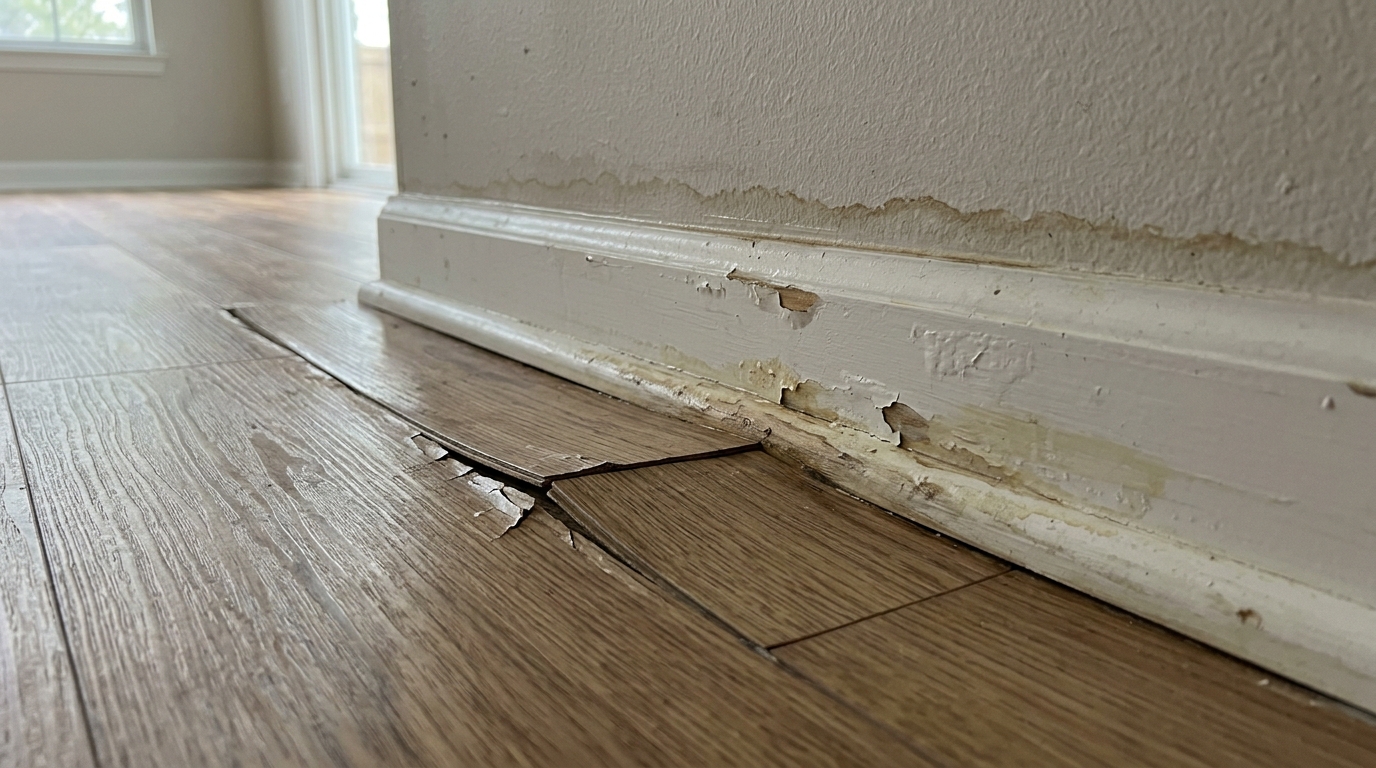
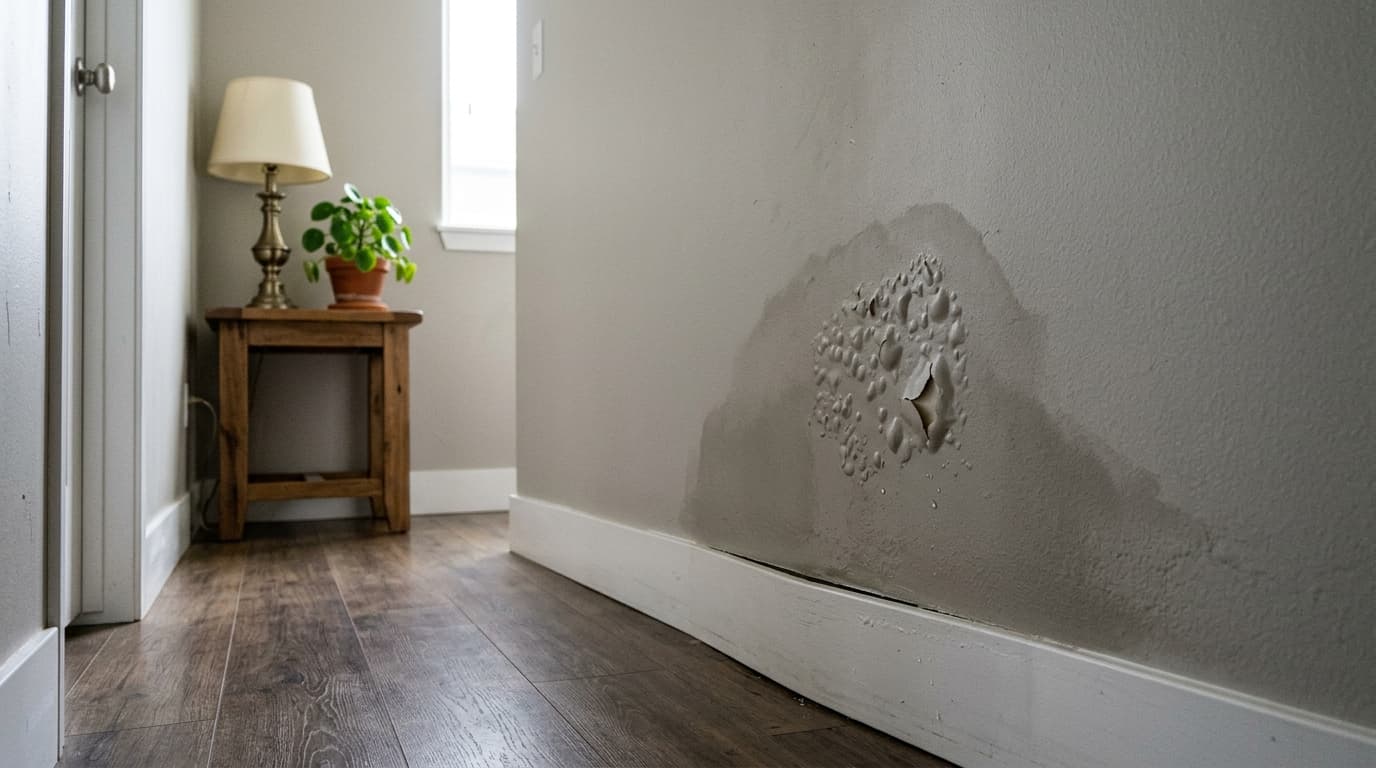
Planks split and tented at the seams, blistered baseboard paint and a tide line on the drywall are what a tank's own contents leave behind after the floor has been mopped.
Material decides most of it:
Sealed concrete usually dries on its own; the loss is what sat on it — cardboard, furniture, the bottom few inches of drywall.
Vinyl plank and sheet vinyl shed water on top; it gets underneath through the seams and stays, so the question is whether the subfloor dried.
Laminate is the least forgiving; its core swells at the seams and does not come back.
Engineered and solid wood sometimes recovers if caught early and dried under control rather than left to air out; separated boards are finished.
Carpet and pad usually part ways: the pad goes, the carpet is judged on its own.
Water that reached a wall does not stay at floor level: it wicks up the drywall paper and into the back of the baseboard, which is why the tide line sits above the floor.
The decision is made by meter, not by eye. Our crews take psychrometric readings and check moisture levels in the affected materials daily, and if day two shows a subfloor cavity still holding moisture, we reposition equipment or add a desiccant dehumidifier. Equipment comes out when the structure hits the dry standard, not when the floor looks dry — the same process we follow for water damage restoration in Coeur d'Alene. Nobody can tell you from a photograph whether your floor is coming out, but the answer is a number, and that number is friendlier on day one than day four.
Get Your Quote
Ready to handle this with a pro?
You're reading about How Do You Check a Spokane Water Heater for Corrosion and Sediment Before It Leaks. Get a fast quote for water damage restoration service in Boise, ID from Apex Restoration.
How Do You Check a Spokane Water Heater for Corrosion and Sediment Before It Leaks?
Spokane's water is hard. The City of Spokane puts local hardness at 147 parts per million, about eight grains per gallon, drawn from the Spokane Valley–Rathdrum Prairie Aquifer. The USGS classifies water between 121 and 180 milligrams per liter as hard, and heating hard water forms calcium carbonate deposits that shorten equipment life, raise heating costs and clog pipes.
Inside a tank they settle into a layer across the bottom. On a gas unit that layer insulates the steel from the burner, so the metal runs hotter than intended; on an electric unit it can bury the lower element. Either way corrosion gets a head start at the bottom seam, where a tank finally opens up.
The check is a flush, run in the same order as the draining section above: gas or power off, the cold inlet closed, and the tank cooled first. It tells you something even when it fails. A homeowner on r/homeowners flushed a heater not drained in seven years and got nothing out of the drain valve. Nothing coming out is itself the diagnosis.
Then there is the anode rod, threaded into the top of the tank to corrode so the tank does not. Let it go past its life and the elements and the tank body begin rusting from the inside. In water this hard, check it sooner rather than later.
The Department of Energy notes that turning a heater down from 140 to 120 degrees reduces scald risk and slows build-up in your pipes, though anyone with a compromised immune system or chronic respiratory disease may want to stay at 140. And on a gas unit, Word of Advice TV suggests feeling the insulation around the burner chamber, with the burner off and cold: wet insulation means a cracked inner tank.
The Bottom Line on a Leaking Water Heater in Spokane
The verdict is simpler than the diagnosis. Water from a threaded connection above the tank, from the drain valve, or from a relief valve reacting to house pressure is a repair. A wet tank body or bottom seam, after everything above it has tested dry, means the tank is done.
The order is what saves you money: close the cold inlet, cut the gas or the breaker, prove the source before anyone buys a part, then look at the floor — the part of this that outlasts the plumbing bill.
We answer the phone 24/7, and when a tank has already emptied itself into a utility room, same-day water damage repair is the difference between drying a room and rebuilding one. The sooner a meter goes on that subfloor, the smaller the decision gets.
Apex Restoration Team
Water Damage & Restoration Specialists
We're the Apex Restoration team — a family-owned, IICRC-certified crew handling water damage, mold, and abatement across Boise, the Treasure Valley, and Eastern Washington & North Idaho. We answer 24/7 and write these guides to help homeowners make calm, informed decisions when water, mold, or hazards show up.
Related Posts
Does Homeowners Insurance Cover Mold Removal in Caldwell?
Homeowners insurance can pay for mold removal in a Caldwell home when the mold traces back to a covered water event, often only up to a limit. Here's how that limit often works, what an adjuster weighs, and what to tell your insurer.
What Should You Do When a Star Garage Floods?
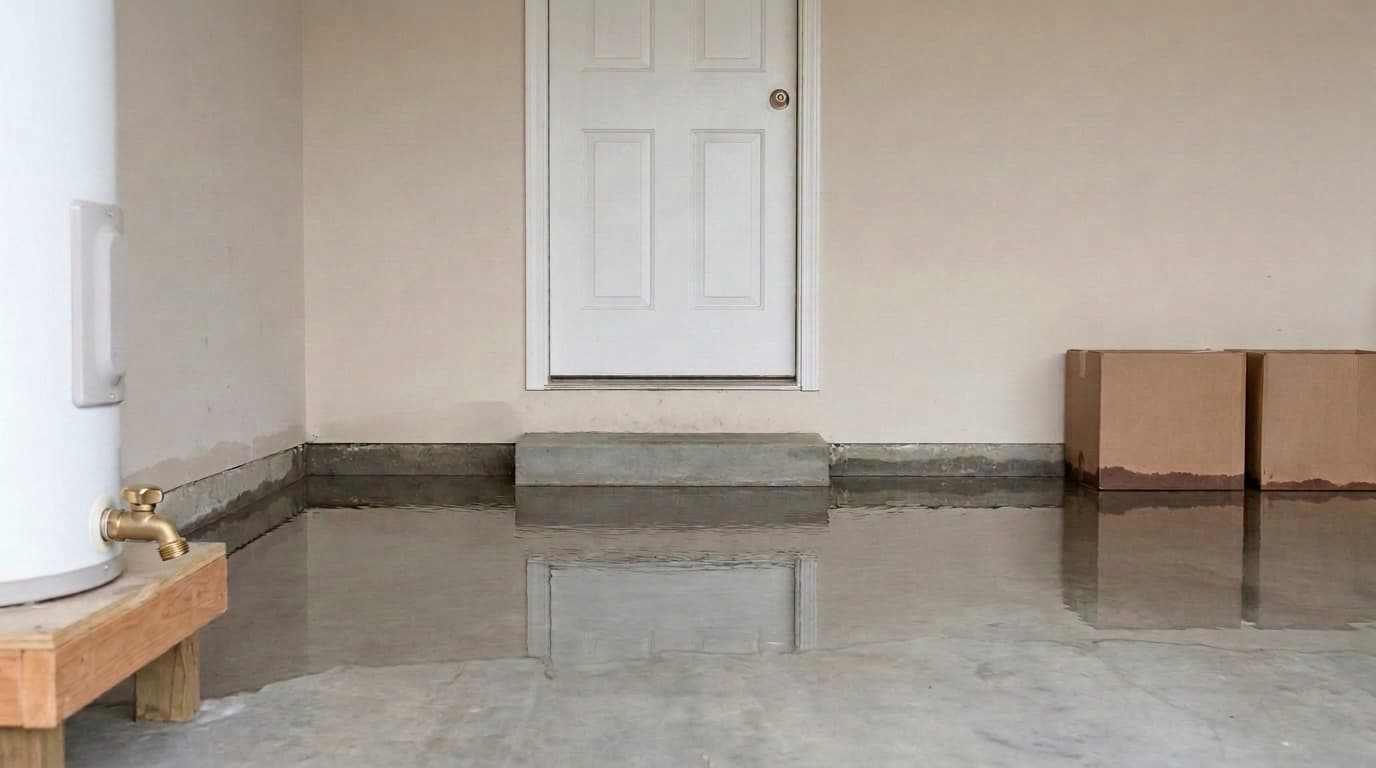
When a water heater or washer floods a Star garage, stay clear of anything electrical the water reached, stop it at the source, and move it away from the house wall. Here's what to check next, and which board Idaho's code calls for when that wall is repaired.
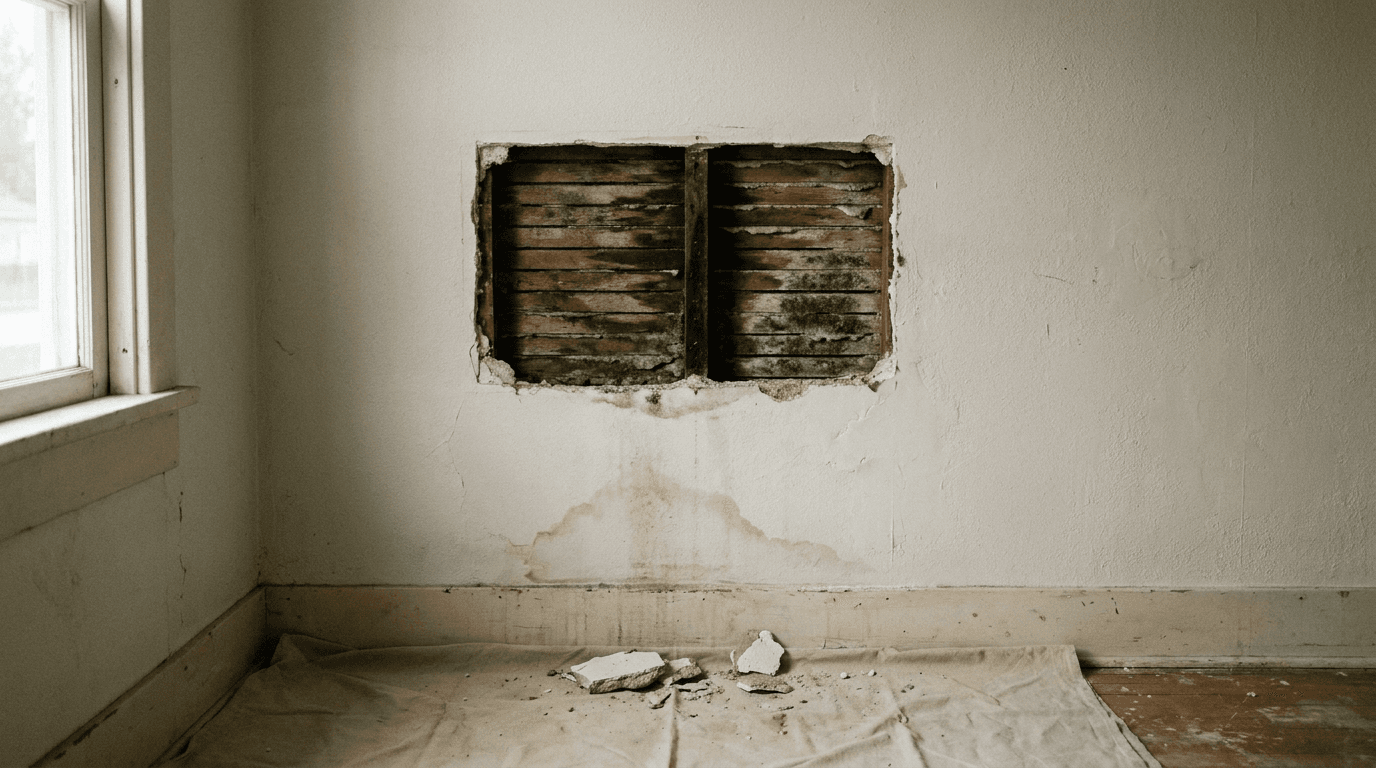
How Do You Find a Water Leak in a Middleton Wall?
A leak inside a Middleton wall can show up in the water bill, a faint running sound or a bubbling paint seam before any stain appears. Here's how to narrow it down, what the City's meter rules mean for you, and when opening the wall makes sense.