
Water Damage on Hardwood Floors in Boise: Signs and Next Steps
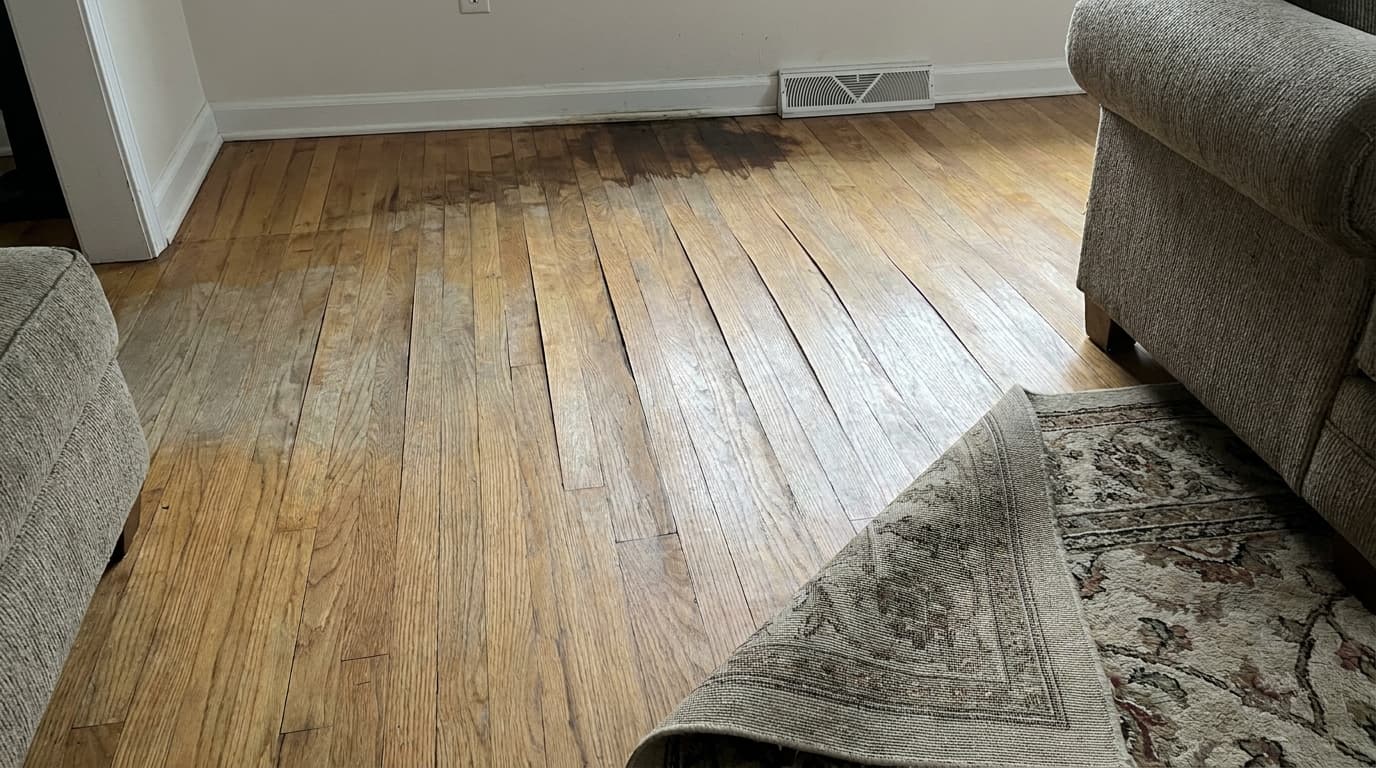
The leak is fixed and the floor still is not flat. You felt it before you saw it: a low ridge along every board edge, a shallow trough down each board. And you have already hit the contradiction. Flooring forums say wait. Restoration companies say call now. Neither tells you which applies to your Boise floor.
There is a way to tell, and it is not opinion. It is a moisture reading — the one we take on every wood floor we look at when we do water damage repair in Boise. Below: what each sign means, how fast it should have appeared, and the measurement that decides what happens next.
Get Your Quote
Ready to handle this with a pro?
You're reading about What Are the First Signs of Water Damage on a Boise Hardwood Floor. Get a fast quote for water damage restoration service in Boise, ID from Apex Restoration.
What Are the First Signs of Water Damage on a Boise Hardwood Floor?
Cupping usually comes first. That surprises people, because the photographs on most articles show buckled boards, and buckling is a late-stage failure. A flooring manufacturer's own guidance calls cupping the first obvious sign a floor is being affected by moisture.
Wood is hygroscopic: it takes moisture from the air, gives it back when conditions change, and changes size doing it. Finish slows that exchange on top but does not waterproof the board. The underside is bare, and water reaches it through seams, board ends, nail holes and scratches.
The signs show up in roughly this order:
Cupping. Edges higher than the middle, so the floor reads as a run of shallow troughs. Felt underfoot before it photographs.
A finish that goes cloudy, blisters or peels. The coating reacts before the wood visibly deforms.
Discoloration, often spreading outward from one point rather than sitting where the spill was.
Soft or spongy spots, new movement, new squeaks. Something under the boards has changed.
New gaps between boards, or seams that feel raised under your hand.
Water squeezing up between boards when you step. Liquid water is trapped under the floor, not on it. That much water can reach floor registers, cords and any wiring in a basement or crawl space below — switch off power to the area at the breaker before you cross it again.
A meter reading well above the rest of the house with nothing visible at all. A sign in its own right.
One more, then we leave it alone: a musty smell near the floor with no visible damage usually means moisture is sitting where you cannot see it. Whether that goes on to grow mold is answered in a separate article on mold after a leak.
Before you check any of this by hand: water from a supply line is clean, but water from a drain line, a dishwasher or washing machine, or outdoor flooding is not. Treat a floor wetted from those sources as contaminated — gloves on, wash up afterwards, and leave the extraction to a crew.
How Do You Tell Cupping From Crowning on Boise Hardwood Floor Boards?
They are opposite shapes. Cupping runs across the width of a board: edges high, center low. Crowning is the reverse, center proud and edges falling away. Both are described in the National Wood Flooring Association's technical literature, and telling them apart takes ten seconds.
Run a flat hand across the boards, perpendicular to the grain rather than along it — gloved, if the water came from any of the dirty sources above. Edges proud of the center is cupping. Center proud of the edges is crowning. Feet find this faster than eyes, and both shapes read best in low raking light.
Cupping means a moisture imbalance inside the board, almost always with more moisture underneath than on top. The wet face swells, the dry face does not, and the board curls away from the damp side. That tells you where to look: under the floor.
Crowning is worth understanding properly, because it is usually not something water did. The NWFA is direct that moisture causing crowning on its own is close to theoretical. Far more often a floor cupped, somebody sanded it flat while the boards were still wet, and the boards then dried and shrank.
The floor did not crown. It was crowned. That is expensive rather than fatal — a crowned floor can be sanded flat again once the boards stabilize — but you have spent wear layer fixing a problem you made.
When Does a Water-Damaged Boise Hardwood Floor Start Buckling?
Buckling is a different category of event. Cupping and crowning are shape changes in boards still fastened down and sound. Buckling means the flooring has separated from the subfloor: boards lifting, a seam tenting, a run standing proud of the floor around it. The NWFA treats excess moisture as the driver behind it in every case.
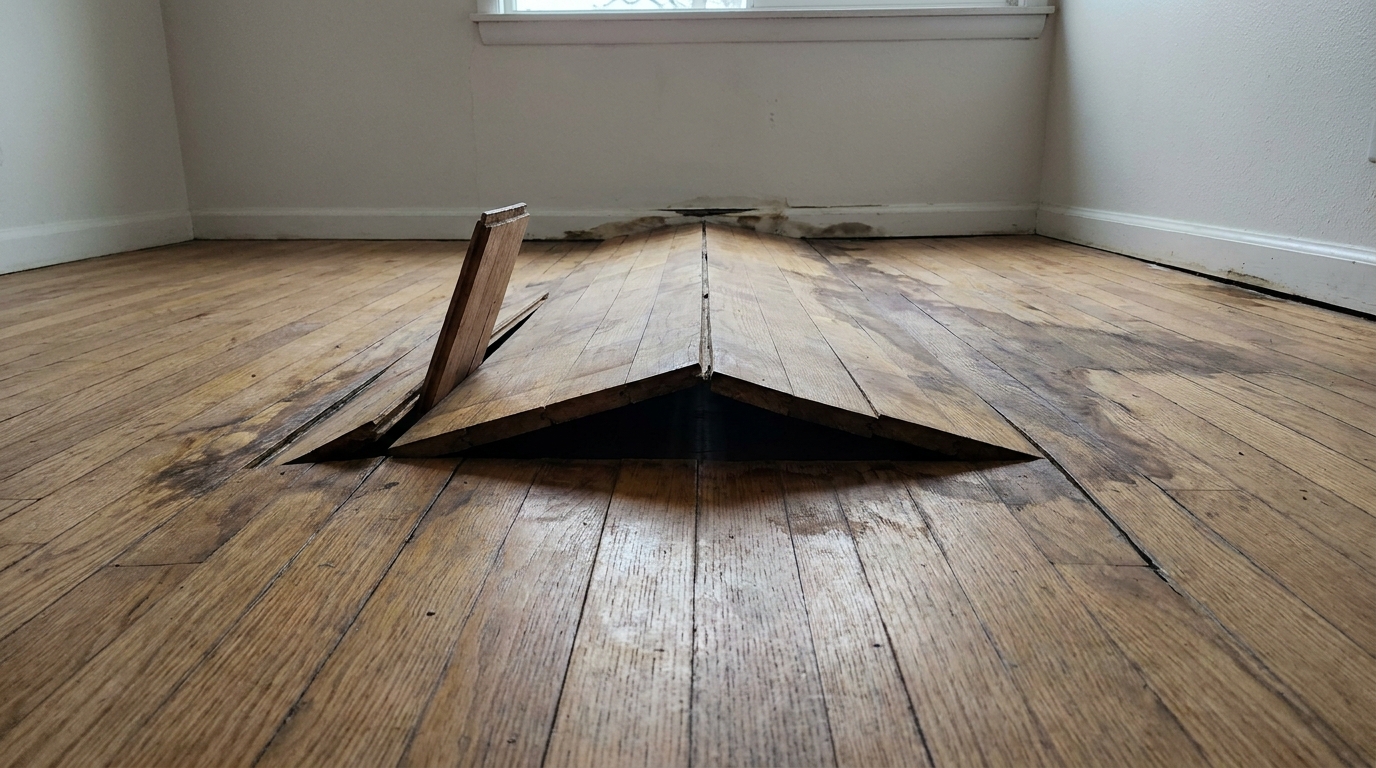
Boards that have stopped being flat and lost their grip on the subfloor. Note the void under the ridge, and the flat floor to either side of it.
The "when" has less to do with elapsed time than with volume. A floor is installed with a small expansion gap hidden under the baseboards. Enough water swells the boards past what that gap absorbs, and with nowhere to move sideways the fasteners let go. So buckling follows floods and long undiscovered leaks.
It also means the water was there in quantity and for a while, which puts the subfloor in question. Buckled boards usually have to come up, and the deck underneath has to be dried before anything goes back. We say "usually" on purpose: the NWFA says judge the damage after the floor stabilizes.
That is the practical dividing line. A cupped floor can be watched. A buckled floor has already failed, and watching does not help. At that point extraction and controlled drying is the job, and it is what our restoration crews do — same-day where we can.
Get Your Quote
Ready to handle this with a pro?
You're reading about Why Do Boise Hardwood Floors Warp Long After the Water Is Gone. Get a fast quote for water damage restoration service in Boise, ID from Apex Restoration.
Why Do Boise Hardwood Floors Warp Long After the Water Is Gone?
This is the part that makes people think the cleanup failed. The leak was fixed in April, the floor looked fine in May, and in July it is wavy. Nothing new got wet. The assembly is still equalizing.
Air does not circulate under a nailed-down floor. When water gets below the boards, the top face — the one in the room, with a fan on it — dries fast, and the underside and subfloor do not. That difference bends the board. The drying itself can produce cupping weeks later.
The second mechanism needs no added water. When room air gets drier, a board's surface shrinks faster than its underside can follow and the edges curl. Idaho supplies that on schedule: the Western Regional Climate Center's Idaho narrative notes that on July and August days above 90 degrees, humidity at maximum temperature is usually below 25 percent, often 15 percent or lower.
Oregon State University Extension's wood-moisture tables put wood near 6 percent moisture content when the air around it holds 30 percent relative humidity, and a Treasure Valley afternoon runs drier. So the room pulls the top of your boards down hard while the underside is still wet — close to a worst case for holding a gradient across a board.
Winter runs the mirror image, because the heating season drops indoor humidity again. The NWFA's framing for a cupped floor returning to shape is weeks, months, or an entire heating season. Warping long after the water is gone is the assembly finding its balance, not a new leak.
How Long Does It Take for Water to Cup a Boise Hardwood Floor?
Faster than most people expect if the water got underneath, and effectively never if it did not. That is the honest answer, and the variable is not time. It is which face of the board got wet.
Where liquid water reaches the unfinished underside, the clock runs in hours to a couple of days. Homeowners describing their own floors bear that out: a portable air conditioner leaking over one weekend cupped a wide area of three-quarter-inch hickory; one dishwasher cycle that never sealed cupped the boards in front of it.
Where there is no liquid event and the driver is humidity or vapor, it runs in weeks to months. The NWFA describes cupping as generally developing gradually, and that slow version is the one it has in mind. It is why a floor can cup with no leak at all.
Species and geometry shift it too: denser woods give up water more slowly, and wide planks telegraph the same moisture difference more visibly than narrow strip. But how fast a floor cupped tells you almost nothing about whether it will flatten.
Which Stains and Discoloration Warn of Subfloor Damage Under a Boise Hardwood Floor?
Color is a first filter, because two kinds of staining sit at different depths. Dark staining — gray patches, blackened board ends, a halo around a fastener — means water penetrated into the wood rather than sitting on the finish. White or cloudy blushing is moisture caught in the finish itself, and it is the better news.
What matters more is where the staining sits and what the floor does underfoot:
Staining that spreads outward from one point, or turns up along walls and at baseboards rather than where the water landed.
Soft or spongy underfoot. The strongest single indicator that the problem is below the surface. It also means the deck has lost strength, not just shape — keep traffic off a spongy stretch, especially over a basement or crawl space, until it is inspected.
Squeaks or movement that are new since the water event, which is fasteners losing grip in a wet deck.
Boards that have loosened, lifted at an end, or started to sound hollow.
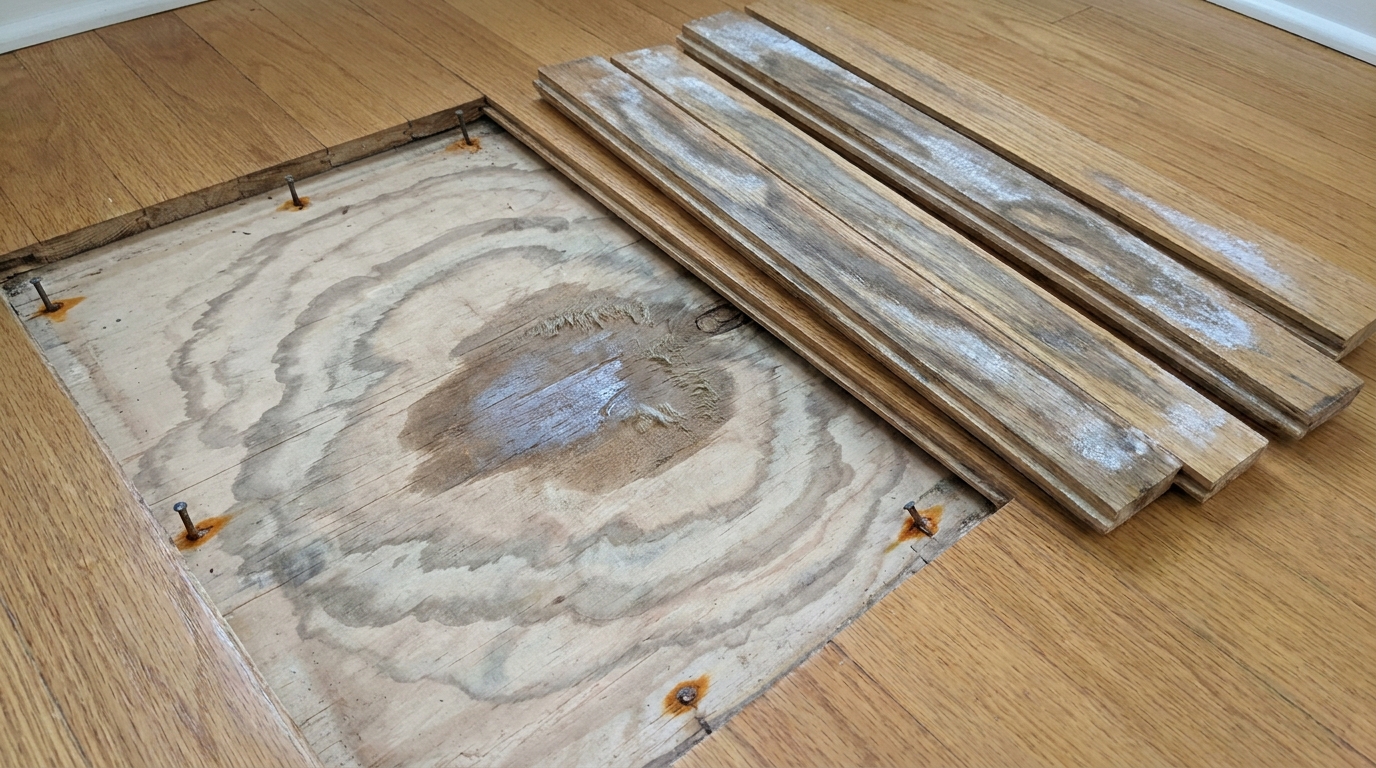
The same tide marks on the subfloor and on the undersides of the boards that covered it. This is what the staining on top was reporting.
Here is the limit of it. Staining tells you moisture was there. It does not tell you whether it still is, and a dried stain and a wet subfloor look identical from standing height. The NWFA is explicit that the source can only be confirmed dead with a meter reading the subfloor, not the boards.
If the same leak came through a ceiling on its way down, that is a different assembly with a different assessment, and it is covered in our guide to ceiling water damage.
Get Your Quote
Ready to handle this with a pro?
You're reading about Can You Tell if a Cupped Boise Hardwood Floor Will Flatten, or Must the Boards Go. Get a fast quote for water damage restoration service in Boise, ID from Apex Restoration.
Can You Tell if a Cupped Boise Hardwood Floor Will Flatten, or Must the Boards Go?
Yes — and this is where the two halves of the internet stop contradicting each other. Flooring people say wait, because most cupped floors do come back. Restoration people say move, because some do not. Both are right about different floors. What decides it is a number, not a shape.
The test comes from the NWFA's Problems, Causes and Cures: a moisture reading taken at two depths in the same board, near the top face and near the bottom. If those readings differ by about a percentage point or more, the board is still giving up water and its shape is not final.
Two caveats. Reading at two depths in one board is not a hardware-store pin-meter job; it takes insulated probes and someone who knows how deep they are driven. This is the reading to ask for, not a weekend project. And it says the floor is still moving, not that it will lay back down.
The second half of the rule is a deadline. The NWFA's position is that if a floor has not settled back flat by the end of a full heating season, the deformation is probably permanent. At that point sanding the cupped edges off becomes a repair rather than a mistake. Together, the two halves give three outcomes:
A gradient of a percentage point or more. Still drying. Nothing gets sanded and nothing gets replaced. Keep drying and read it again later.
Under a point, and the boards have flattened. Finished. What is left is cosmetic, and the call is yours.
Under a point, still cupped, a full heating season gone by. Treat the shape as final: sanding flat or replacing boards is now the honest recommendation.
Which path is open is a measurement, not a category. Solid three-quarter-inch hardwood can be sanded flat. Engineered flooring can be sanded only if the wear layer is thick enough, and flooring distributor RW Supply+Design puts that at three millimeters or more. Laminate is not wood; once the core swells, planks get replaced.
If you do sand, plan on sanding the whole floor, because a patch will not match, and expect new gaps where swollen boards crushed their own edges. A recoat is not a repair either: it fixes dullness and light peeling, not loose boards or staining down in the wood. Once a floor tests dry and is sound, whether the remaining waviness is worth money is your call, not a contractor's.
"Later" is longer than most people want. A self-identified hardwood installer on Reddit told a homeowner to wait eight months or more; their own floor took about a year. Another homeowner reported close to a year and a half. A flooring contractor answering a different cupping thread reaches for the same one-point gradient.
How much of the floor gets replaced is not really a technical question. Physically, new boards can be laced in and blended when the floor is refinished. What your carrier will pay for is separate, and we cover it in our post on what homeowners insurance covers in Idaho.
The Bottom Line on Water-Damaged Hardwood Floors in Boise
Cupping is the early sign, not the disaster. Buckling is the one that means the fasteners have let go. Between them, nearly everything you can see on a water-damaged floor is a shape — and a shape is not evidence of anything except that the board is not finished.
The mistake that costs real money is sanding too early, and it is self-inflicted. Wait for the reading. A floor still showing a gradient between top and bottom is still moving, and sanding it today only risks a crowned floor later. Boise's dry air is doing half your drying and half your damage at once.
Once it is behind you, the maintenance list is short. Hold indoor humidity in a moderate band; the EPA's guidance for homes is 30 to 50 percent relative humidity. Never wet-mop or steam-clean hardwood. Check the supply lines behind the dishwasher, refrigerator and washing machine once a year.
What we bring to a wavy floor is not urgency. It is a reading at depth, a separate reading of the subfloor, and a straight answer about whether the shape is final. Our technicians are IICRC-certified — the restoration industry's technician certification — and we work across Meridian and the Treasure Valley too. If you cannot read your own floor, we are glad to come read it.
Apex Restoration Team
Water Damage & Restoration Specialists
We're the Apex Restoration team — a family-owned, IICRC-certified crew handling water damage, mold, and abatement across Boise, the Treasure Valley, and Eastern Washington & North Idaho. We answer 24/7 and write these guides to help homeowners make calm, informed decisions when water, mold, or hazards show up.
Related Posts
What Should You Do When a Star Garage Floods?
When a water heater or washer floods a Star garage, stay clear of anything electrical the water reached, stop it at the source, and move it away from the house wall. Here's what to check next, and which board Idaho's code calls for when that wall is repaired.
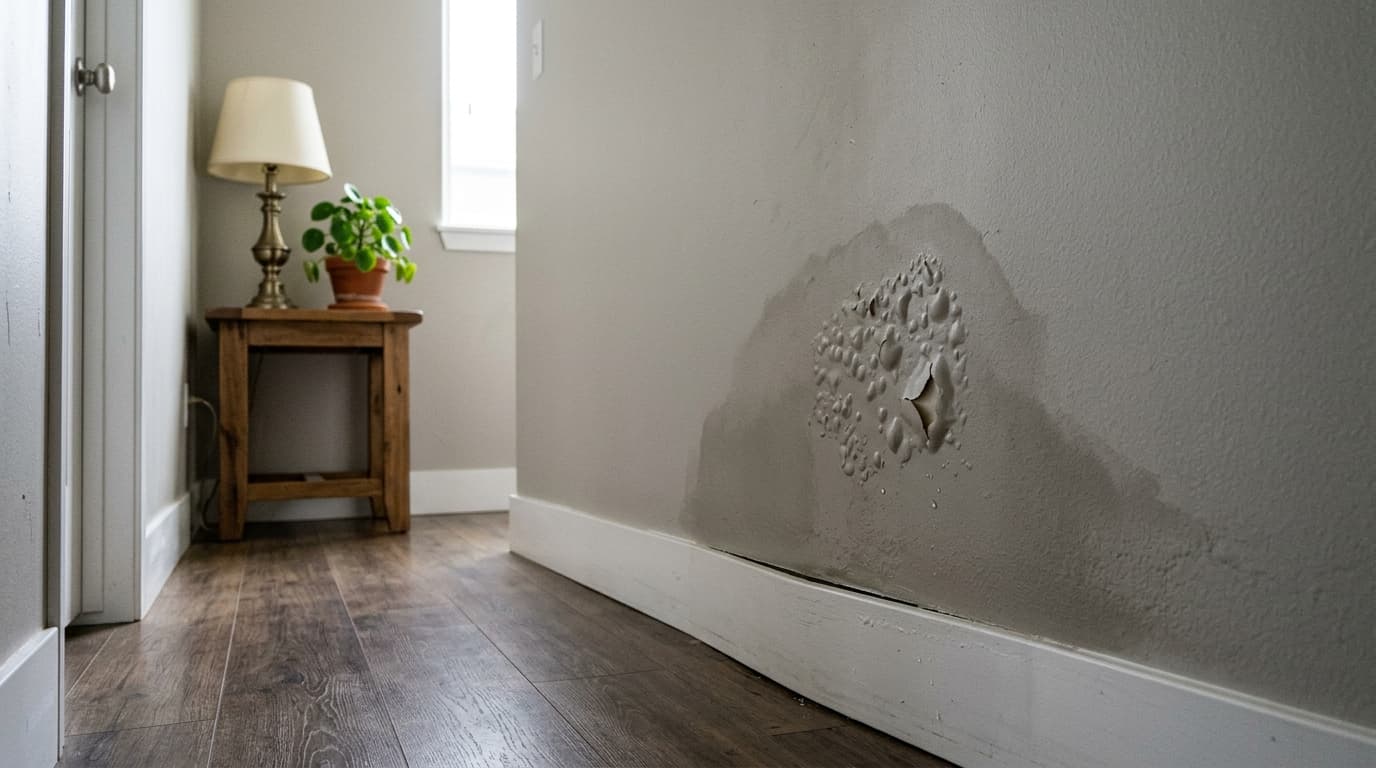
How Do You Find a Water Leak in a Middleton Wall?
A leak inside a Middleton wall can show up in the water bill, a faint running sound or a bubbling paint seam before any stain appears. Here's how to narrow it down, what the City's meter rules mean for you, and when opening the wall makes sense.
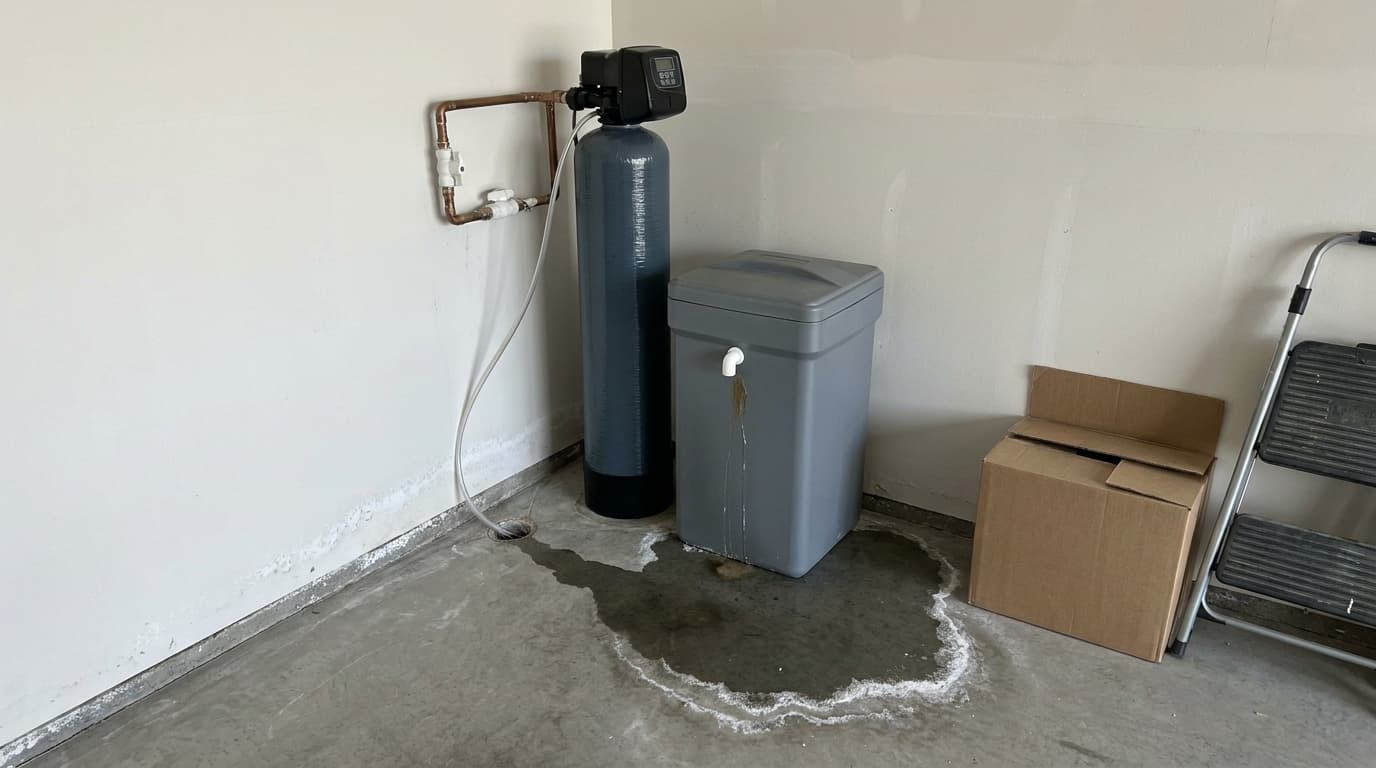
Is Your Garden City Water Softener Leaking Onto the Slab?
A leaking water softener is often a small repair, but brine is salt water, and the salt stays behind when a leak dries. Here is how to trace the leak, stop it safely and spot salt damage in Garden City drywall and framing.