
Why Does Black Mold Keep Coming Back in Meridian Bathrooms?
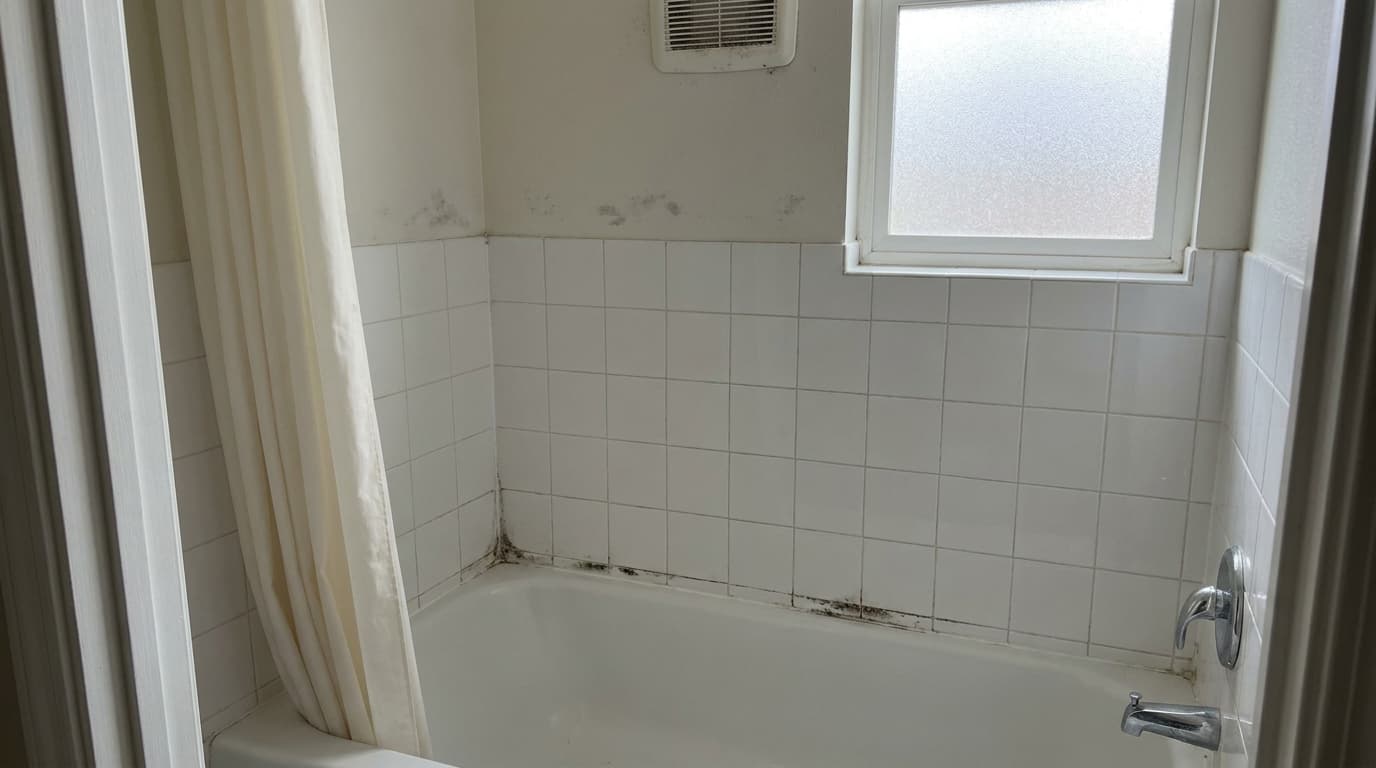
If black spots keep returning to your shower after every scrub, look at where they come back. Idaho's Department of Health and Welfare states the rule on its mold page: mold will return if the source of moisture is not fixed. We sort bathroom moisture into two patterns, each with its own fix:
Steam the room can't shed. Growth comes back wherever the room stays wet, the same grout lines and caulk included. The U.S. Environmental Protection Agency says, in A Brief Guide to Mold, Moisture and Your Home, that when bathroom mold seems to reappear, increasing ventilation and cleaning more frequently will usually prevent it from recurring, or at least keep it to a minimum.
Water getting in. Your fan already passes the checks below, yet growth still returns to one tile, grout line or stretch of caulk while everything around it stays clean. A better fan won't reach that water.
Whether it's "black mold" won't tell you which pattern you have, and we've explained why the black mold label is the wrong question to chase. When water is getting in, the fix is finding it and, once it has soaked into the wall or floor, mold remediation, which we do for Meridian homeowners.
Get Your Quote
Ready to handle this with a pro?
You're reading about How Do You Tell Surface Mold From Mold Behind a Meridian Shower Wall. Get a fast quote for water damage restoration service in Boise, ID from Apex Restoration.
How Do You Tell Surface Mold From Mold Behind a Meridian Shower Wall?
Surface growth sits on the face of the tile, grout or caulk, scrubs off, and leaves the wall around it solid. Mold behind the wall may show you only its edge. Clues you can check by eye and by hand:
Tile that moves, flexes or sounds hollow when you press or tap it. Go gently, because an American Society of Home Inspectors (ASHI) article on tiled showers and shower pans warns that thin cracks through tile are often razor sharp.
A soft wall, especially near the bottom row of tile.
Cracked, crumbling or missing grout, especially at the inside corners.
Damage on the other side of the wall, such as peeling paint or a low stain in the room or closet next door.
A musty smell that lingers after the room dries, with no growth in sight.
These clues don't prove hidden mold on their own, but they do mean the wall is no longer a cleaning job. EPA's guide cautions that investigating hidden mold can mean disturbing places where it may be growing, and it suggests considering an experienced professional if you believe you have a hidden mold problem. So leave the tile on and the wall closed.
What Are the Signs a Meridian Bathroom Fan Is Feeding the Mold?
A weak fan leaves the whole room wet after every shower, so its growth can return to the same grout lines and caulk, not only to the ceiling, the upper walls and the grille. Check it first: it's usually the cause you can fix without opening a wall. Signs to look for:
A fan that can't hold a tissue. The U.S. Department of Energy's Building America Solution Center guide to bathroom exhaust fans notes that a bathroom fan should have enough suction to hold a tissue. With the fan running and the grille in place, hold a single square near it. If the fan can't hold it, it's moving too little air.
A fan that's too small. The Home Ventilating Institute's bathroom ventilation guidelines recommend 1 CFM (cubic feet per minute) of exhaust per square foot for bathrooms up to 100 square feet, and base larger rooms on the number and type of fixtures.
A fan that goes off when you leave. The institute recommends leaving the fan on for 20 minutes after using the bathroom and calls a timer a good way to shut it off. A fan that shares the light switch usually goes off when the light does.
A fan that doesn't vent outside. The Department of Energy guide says to vent the fan outdoors, not into an attic, a crawlspace or the space between floors, and has installers confirm that the fan exhausts rather than recirculates, the outside damper opens freely and the packing tape is removed.
Drips or rust at the grille in winter. The same guide calls for insulating the duct to minimize condensation. In a cold Meridian attic, an uninsulated duct can send that condensation back toward the fan.
Fan repairs belong to an electrician or an HVAC contractor. Our part starts once a fan problem has left water or growth behind in the ceiling, wall or attic.
Where Should You Look for Mold Around a Meridian Tub and Shower Joint?
Water runs along the seam where the tub or shower base meets the tile, so a failed seal there gives it a direct route behind the wall. Check these spots:
The caulk bead. Growth on a bead that is stuck down along its whole length is surface growth. Growth under the bead, or a bead that has cracked, shrunk or pulled away, means the seal has a gap.
Inside corners and grout lines. Look for vertical cracks where two walls meet and for grout washed out of the corners or horizontal joints. The ASHI article flags these and notes that any missing grout or caulking can cause a substantial amount of damage if it isn't repaired quickly.
A sliding door's bottom track, where growth can hide underneath.
The floor just outside, where lifting vinyl, a tile that rocks or a swollen baseboard deserves a closer look.
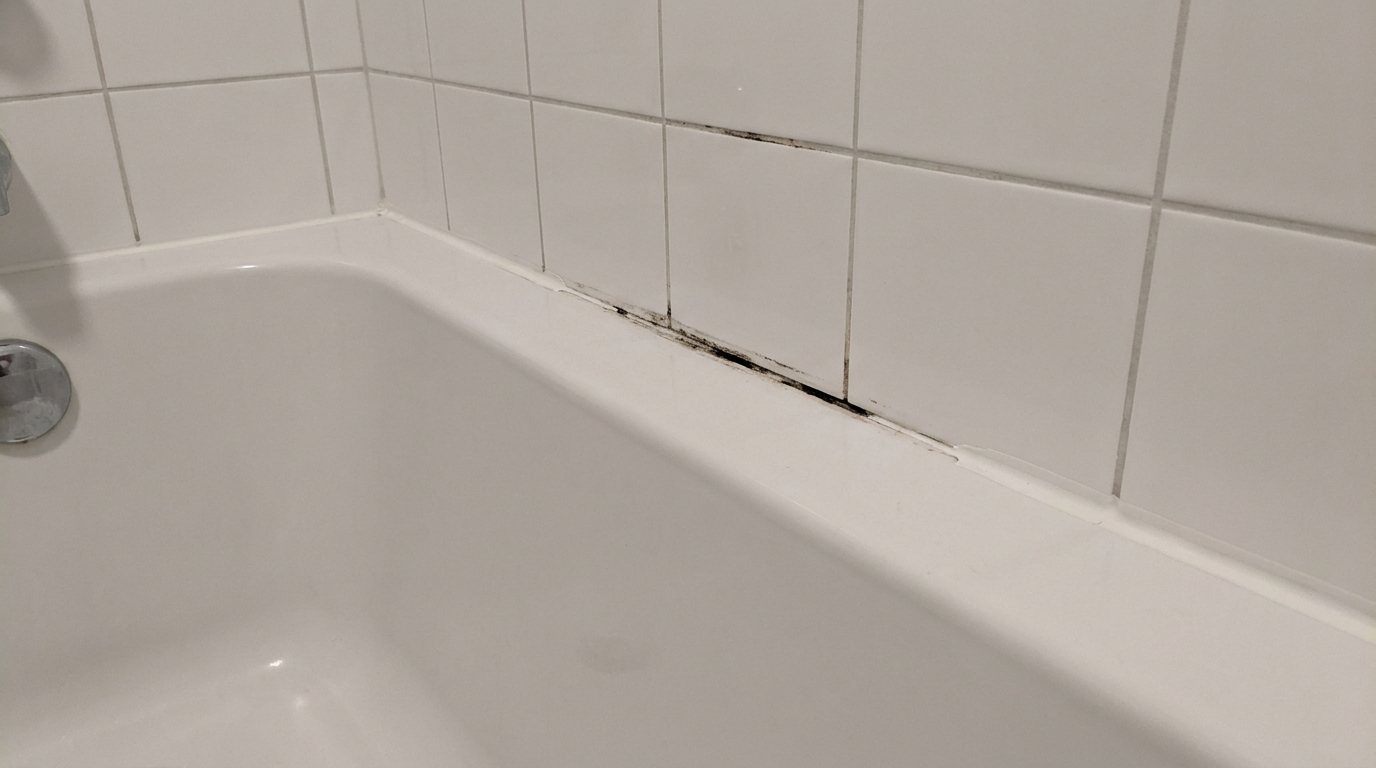
If the bead is sound and the growth wipes off, it's steam. A bead that has let go needs a new seal, laid only after the mold is cleaned up and the joint is dry, as EPA's method below explains. If the tile beside a failed joint moves or sounds hollow, water has likely been getting in for a while, which makes it a wall problem. Check the wall behind the toilet tank and the floor of the sink cabinet, too.
Get Your Quote
Ready to handle this with a pro?
You're reading about How Long Does Mold Take to Come Back on Meridian Bathroom Grout. Get a fast quote for water damage restoration service in Boise, ID from Apex Restoration.
How Long Does Mold Take to Come Back on Meridian Bathroom Grout?
We can't give you a reliable number of days, because it depends on how long your grout stays wet between showers. That's also what makes the speed of the return useful.
First, rule out a stain. EPA's guide notes that mold may cause staining and cosmetic damage, and that it may not be possible to clean an item so that its original appearance is restored. A shadow in the grout that looks the same from week to week is probably a stain. Growth that spreads, darkens or turns fuzzy is coming back.
Then read the return against the fan. Regrowth that slows once the fan moves enough air and runs longer points to steam, even when it keeps coming back to the same grout lines. If your fan already passes the checks above and one or two lines still grow back fast, with no change when you ventilate more, that grout isn't drying, most likely because something keeps it wet from behind or through a crack.
To test it, fix anything the fan checks turned up, then run the fan longer, leave the door open after showers and wipe down the walls for a while. If regrowth slows, steam was driving it. If the fan passes those checks and one spot still keeps its schedule, treat it as a water problem.
What Does It Tell You When Mold Returns to the Same Meridian Tile?
On its own, not much yet. A weak fan can keep the same grout wet shower after shower, so start with the fan checks above. If your fan already passes those checks and one tile or a short run of grout still keeps growing back while its neighbors stay clean, something is likely delivering water to that spot. Look nearby for:
a crack or gap in the grout or caulk, or where the tile meets a niche, a shelf or the valve trim;
a ledge, soap dish or corner the spray hits hardest, where water sits longer;
a loose or hollow-sounding tile, which can mean the material behind it is breaking down.
Idaho's Department of Health and Welfare advises that if mold comes back, you repeat the cleaning steps or consider replacing the material. For a joint that keeps failing, replacement is often the real fix. If the tile moves, or the spot returns after the joint is redone and the fan still passes, water has probably reached the material behind the tile, and that is where a restoration job starts. At that point, stop scrubbing the spot and have it looked at.
When Is Mold a Sign a Meridian Shower Pan Has Failed?
When growth and dark grout gather along the bottom of the walls and the curb, and signs of water appear outside the shower. The ASHI article explains that most tiled showers rely on an unseen liner, the pan, installed between the tile and the subfloor to keep water from leaking into the structure, though some showers use a prefabricated base instead. Where water from a failed liner shows up depends on what's under your Meridian bathroom:
On a concrete slab, the article lists stained baseboards or wood trim nearby, and loose floor tiles in the bathroom or in areas sharing a common wall, as red flags, and says to check the lower walls and floor of any closet that backs up to the shower for signs of water.
Over a crawlspace, the article says leaks often show up first in the drain area below and are seldom discovered before the damage is substantial. If you're seeing the other signs, have the crawlspace under the shower checked.
Newer homes aren't exempt. The article notes that improperly installed new pans, or liners damaged during construction, can leak soon after they're put to use, while older pans wear out.
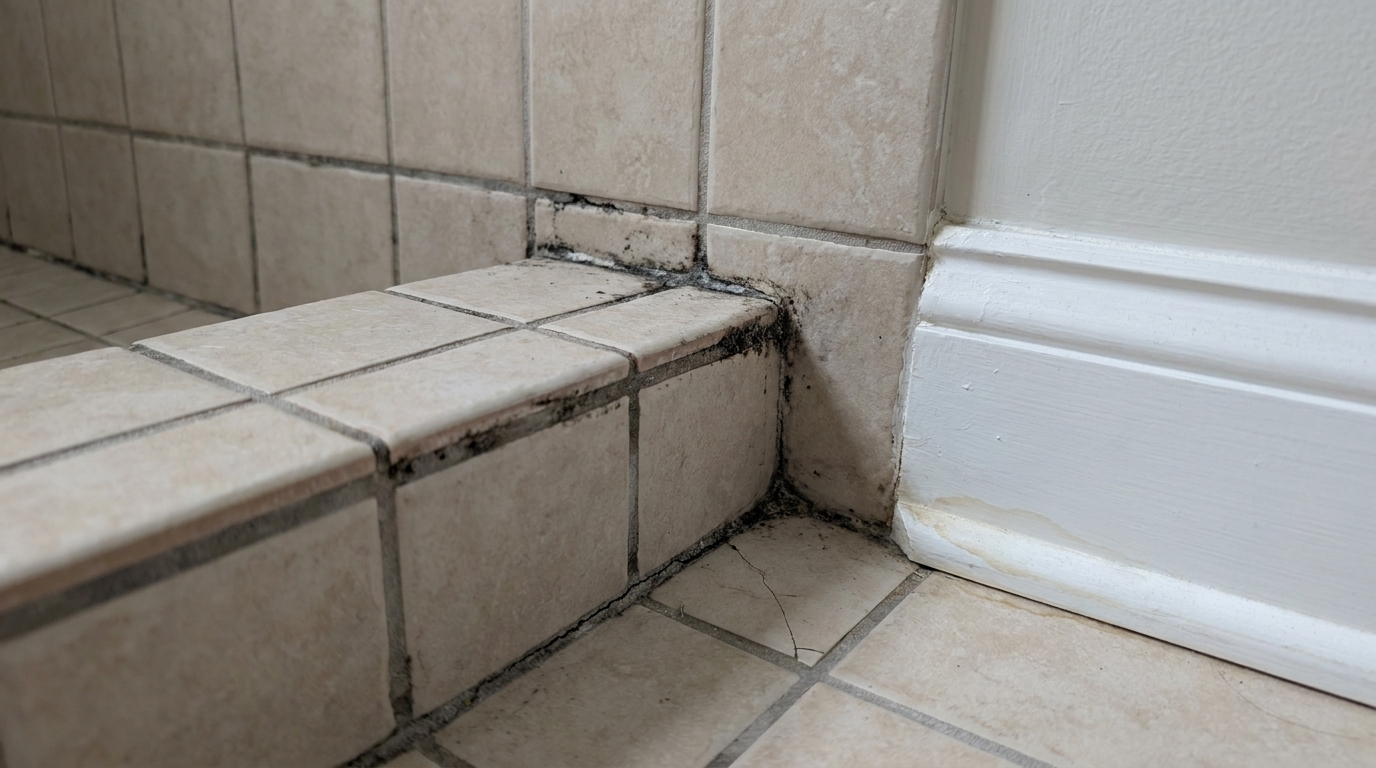
Confirming that the pan is really the leak is a plumber's job, and it should happen before any tile comes out. We're not plumbers. Our part is what the leak left behind: drying the subfloor and the wall, and removing anything moldy or too wet to save. Our crews do that work across the Treasure Valley, including water damage restoration in Nampa, and our guide on whether water damage leads to mold explains how hidden water becomes a mold problem.
Get Your Quote
Ready to handle this with a pro?
You're reading about How Do You Know Which Meridian Bathroom Mold Is Safe to Clean Yourself. Get a fast quote for water damage restoration service in Boise, ID from Apex Restoration.
How Do You Know Which Meridian Bathroom Mold Is Safe to Clean Yourself?
Start with size and surface. EPA's guide, A Brief Guide to Mold, Moisture and Your Home, says that if the moldy area is less than about 10 square feet, roughly a 3-foot by 3-foot patch, you can in most cases handle the job yourself. Four situations change that answer:
A lot of water damage, or growth over 10 square feet: EPA points you to its guide Mold Remediation in Schools and Commercial Buildings, which it says applies to other building types too.
Sewage or other contaminated water caused the damage: EPA says to call in a professional with experience cleaning and fixing buildings damaged by contaminated water.
You suspect the heating, ventilation and air conditioning (HVAC) system is contaminated with mold: EPA says not to run it, because it could spread mold throughout the building, and to consult its guide Should You Have the Air Ducts in Your Home Cleaned? first.
You have health concerns: EPA says to consult a health professional before starting cleanup.
In a bathroom, the hard surfaces EPA's scrub step is meant for are tile, glass and a fiberglass or acrylic tub or surround. Painted drywall is absorbent, so step four applies to it. If you've seen the behind-the-tile or shower-pan signs above, the size of the visible patch stops mattering.
If the job passes those tests, this is EPA's method, with the protective gear first:
Protect yourself and others before you start. EPA says to avoid exposing yourself or others to mold. It says you may want to wear an N-95 respirator, and that it must fit properly, so follow the instructions supplied with it. It recommends long gloves that reach the middle of the forearm: household rubber gloves are fine with water and a mild detergent, but with a disinfectant, a biocide such as chlorine bleach, or a strong cleaner, choose natural rubber, neoprene, nitrile, polyurethane or PVC. Add goggles without ventilation holes, and avoid touching mold or moldy items with bare hands.
Fix leaks and other water problems as soon as possible, and dry everything completely.
Scrub mold off hard surfaces with detergent and water, and dry them completely.
Expect porous materials to go. EPA says absorbent or porous materials may have to be thrown away if they become moldy, because mold can grow on or fill in their empty spaces and crevices and may be difficult or impossible to remove completely.
Don't paint or caulk over mold. Clean up the mold and dry the surface first.
Go easy on bleach. EPA does not recommend a biocide such as chlorine bleach as a routine practice in mold cleanup, though it notes that professional judgment may indicate its use in some instances, and it says it is not enough to simply kill the mold; it must also be removed. If you choose to use a disinfectant, EPA says to always ventilate the area and exhaust the air to the outdoors, and never to mix chlorine bleach with other cleaning solutions or detergents that contain ammonia, because toxic fumes could be produced.
Consider a specialist if you're unsure how to clean an item, or if the item is expensive or has sentimental value.
The list doesn't cover a moldy exhaust fan housing, which is wired equipment and belongs with the fan fixes above. Once you've cleaned, keep an eye on the spot. If the mold comes back, go back to the moisture: the fan, the seal or a leak.
The Bottom Line
Idaho's Department of Health and Welfare says mold will return if the source of moisture is not fixed.
Growth that slows once the fan moves enough air and runs longer points to steam, even on the same grout lines. For bathroom mold that seems to reappear, EPA says increasing ventilation and cleaning more frequently will usually prevent it from recurring, or at least keep it to a minimum.
If your fan passes its checks and growth keeps returning to one tile, grout line or caulk joint while the rest stays clean, water is likely getting in at that spot.
Tile that moves or sounds hollow, a soft wall, cracked or missing grout, damage on the other side of the wall, or a musty smell with no growth in sight means the wall is no longer a cleaning job.
EPA's line for doing it yourself is a moldy area under about 10 square feet, in most cases, with its protective gear and method. Its guide points you elsewhere after a lot of water damage, for sewage or other contaminated water, or for an HVAC system you suspect is contaminated, and to a health professional first if you have health concerns.
Growth along the bottom of the shower walls and the curb can point to a failed shower pan when signs of water also show up outside the shower. Confirming that the pan is really the leak is a plumber's job. Drying and removing what the leak left behind is ours.
If your fan passes the checks above and mold still keeps returning to the same spot in your Meridian bathroom, have someone look behind it. We answer 24/7, and here is how we handle bathroom mold that goes deeper than the surface.
Apex Restoration Team
Water Damage & Restoration Specialists
We're the Apex Restoration team — a family-owned, IICRC-certified crew handling water damage, mold, and abatement across Boise, the Treasure Valley, and Eastern Washington & North Idaho. We answer 24/7 and write these guides to help homeowners make calm, informed decisions when water, mold, or hazards show up.
Related Posts
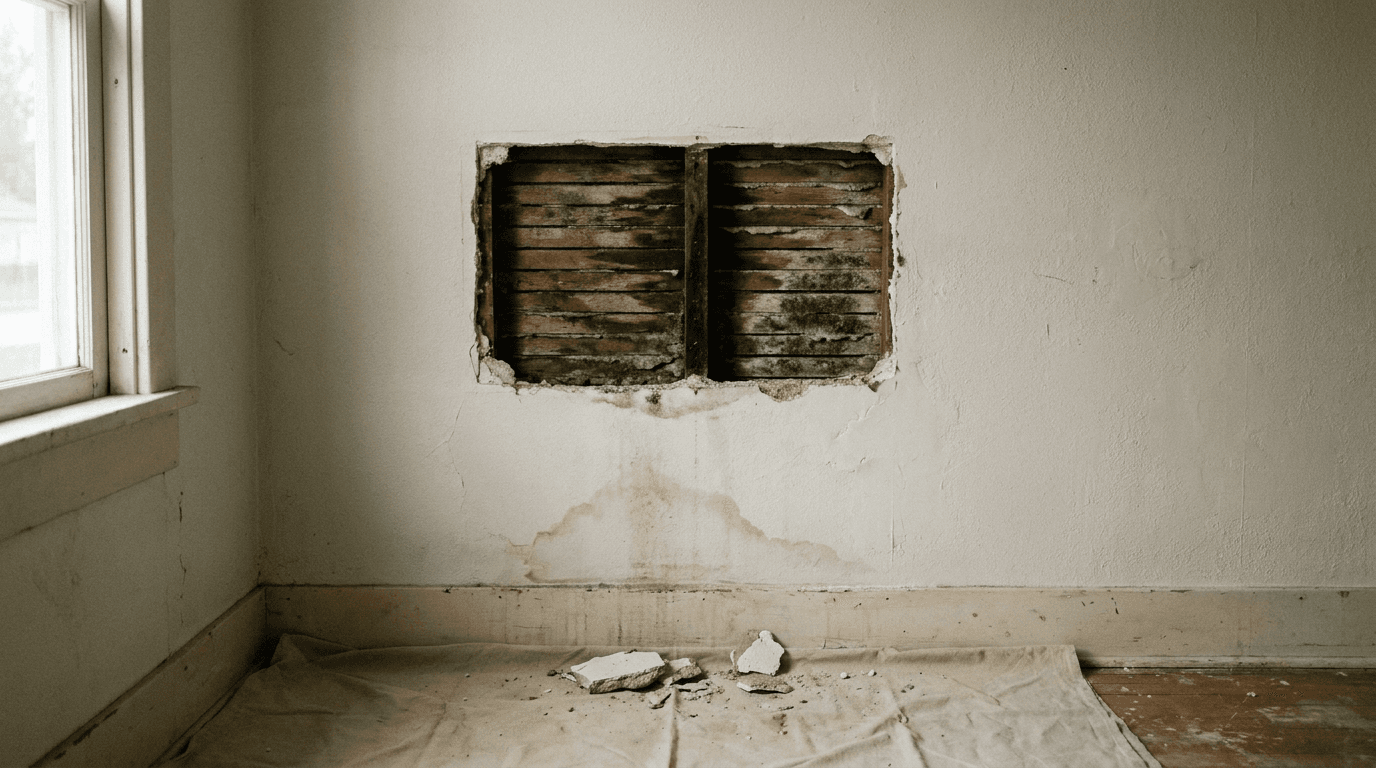
Does Homeowners Insurance Cover Mold Removal in Caldwell?
Homeowners insurance can pay for mold removal in a Caldwell home when the mold traces back to a covered water event, often only up to a limit. Here's how that limit often works, what an adjuster weighs, and what to tell your insurer.
What Should You Do When a Star Garage Floods?
When a water heater or washer floods a Star garage, stay clear of anything electrical the water reached, stop it at the source, and move it away from the house wall. Here's what to check next, and which board Idaho's code calls for when that wall is repaired.
How Do You Find a Water Leak in a Middleton Wall?
A leak inside a Middleton wall can show up in the water bill, a faint running sound or a bubbling paint seam before any stain appears. Here's how to narrow it down, what the City's meter rules mean for you, and when opening the wall makes sense.